
The Great Gatsby and the Nature of Novels and Film

From what I’ve gathered, the majority opinion on Baz Luhrmann’s adaptation of The Great Gatsby believes that it’s an unfaithful work that does the source material a disservice. But, while I can understand grievances over some of this film’s embellishments (and one heinous plot addition), on the whole, the problems with 2013’s Gatsby are basically the same as those of the original book.  They’re simply exacerbated because of the nature of cinema vs. novels.

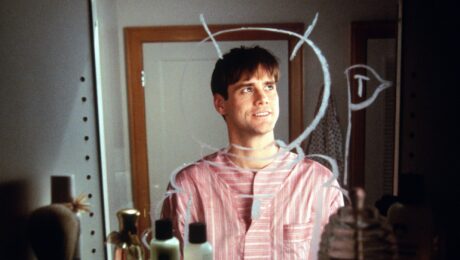
This is my world, and you’re all just living in it.

F. Scott Fitzgerald’s Great American Novel is set in the 1920s and follows the hopes and dreams of nouveau-riche Long Islander Jay Gatsby (Leonardo DiCaprio).  Gatsby, initially a shadowy and mysterious figure, owns a mansion from which he throws the most inclusive and ornate parties in New York.  Of course, Gatsby—who really tried to ruin courtship for all future generations of guys—throws his parties, owns his house, and does everything all for the love of one woman: the flighty, eminently-susceptible Daisy Buchanan (Carey Mulligan).  That Daisy’s voice “is full of money” doesn’t seem to register as a negative to Gatsby, nor does her marriage to the old-money, traditionalist snob Tom Buchanan (Joel Edgerton).

Continue reading

Count Gauntly’s Horrors from the Public Domain: Brian Terrill’s entry into the world of horror hosts

Are you a connoisseur of bad movies? Do you appreciate ”the creepy, the strange, and the poorly and cheaply produced?” Looking for an overview of films so inessential or poorly curated that their copyright has lapsed?

If you live in Northern Virginia, you need look no further than your local television channel. Beginning this spring, you can tune into County Gauntly’s Horrors from the Public Domain, Brian Terrill’s television show in the tradition of classic horror hosts.

The first two episodes of County Gauntly’s are currently airing at various times and days on Fairfax Channel 10. You can find the airtimes on the Count Gauntly’s facebook page.

I sat down with Brian, the host of County Gauntly’s who showed up for the interview dressed in character, to talk a little bit about his show and its origins.

Continue reading

Creating art is a lot like taking a crap, says Fall Out Boy guitarist

trohman

The AV Club is one of my favorite sites on the web. I love many of their features (as I’ve noted in the past, the New Cult Canon column by Scott Tobias was what directly inspired me to recruit Grant and get this site going).

Probably my least favorite recurring feature on the site is HateSong, in which they ask minor celebrities what their least favorite song is, then ask them to elaborate. It’s basically asking people (most of whom aren’t comedians) to be funny on command.

A couple of the articles have been insightful in somewhat obvious ways (“I think Weezer has put out some songs I really hate because they’ve also put out a lot of songs I really like”), but most of the six or seven entries in the series that I’ve read have been a waste of time.

There’s something special in this week’s rant by Fall Out Boy guitarist Joe Trohman, though. The target is “Mambo No. 5″ but the discussion veers off into a few interesting topics: Using singles to evaluate the overall value of a band, sampling older songs, Tommy Tutone, the interviewer’s friend who used to always dress like Lou Bega at parties, and — my favorite — the analogy between creation and defecation. It’s one of the most amazing things I’ve read in awhile. You can read the quote below and the full discussion here, which I recommend.

I can think of songs that Fall Out Boy wrote, some of our older songs, that are really not my favorite. I’ve learned to not try to throw myself under the bus too much, though. Or my band members.

I’m also a guy who will make a record or a song, and I won’t be able to listen to it afterward. It doesn’t mean it isn’t good, it’s just—this is a really bad way to say it—but it’s like taking a shit. Like, “Oh that felt great! I’m so glad, that was so cathartic.” But I don’t want to look at it. I don’t want to hang out with it. But here’s a difference: I do have to hang out with it. Often, I have to hang out with those little shits.

At the end of the day, I like the music and am proud of that stuff, even the bad stuff. It’s like having tattoos. I have a lot of tattoos and probably, at the end of the day, regret the idea of having tattoos. But I have a lot of good tattoos, and I have my bad tattoos I started out with. I can’t have my good ones without my bad ones, so I kind appreciate the bad ones even more. And I feel that way about the worst songs I’ve been a part of making. I have to make those. I have to be completely naked in front of people and show my disgusting body to people so that I can learn to maybe tone it up a little bit. Maybe look a little better naked.

Ranking the tracks on Bruce Springsteen’s Born to Run and Born in the USA

btrbitusa

Bruce Springsteen’s two biggest and best-known albums are his Borns. Born to Run came out in 1975 as Bruce’s third album and catapulted him to superstardom. Born in the USA came out nine years later as Bruce’s seventh album. Both were massive successes critically and commercially.

The themes of the albums tie together quite well. Born in the USA serves as a twenty-years-later sequel to Born to Run. Both consider small town traps and the American dream.

In Born to Run, Bruce emphatically rejects complacency. His subjects are kids and young adults who have no interest in dreaming big or loving deeply.

Born in the U.S.A. shows a softer and more grown up side of Springsteen. His subject is older Americans whose chance at breaking free are long past. But he now depicts a pride and sentiment in staying loyal to humble roots.

What the albums have in common is that they are two of Bruce’s best and most accessible albums. Their thematic and nominal links make them natural partners.

I’ve been listening to them a lot recently, and I started wondering what a comparison might look like stacking up the twenty tracks on the two albums (8 on Run, 12 on USA) next to each other.

Continue reading

Read my recaps of Game of Thrones, Season 3

cg

got

I’ve been recruited to write episode recaps for the third season of Game of Thrones over at CharacterGrades.com! Character Grades uses the format of a report card for characters from the series with a tongue-in-cheek tone.

I started with a round-up of the second season and then wrote a recap of “Valar Dohaeris,” the first episode of Season 3.

Join me every Monday morning!

Reimagining Billy Joel’s Glass Houses as a Concept Album

glasshousesposter

I’ve made it through six albums in my ongoing Billy Joel retrospective, which means it’s time to write a review for his seventh: Glass Houses. It’s certainly one of Joel’s best albums, and I’ve been listening to it again recently in preparation for writing the review.

There’s one thing I noticed that I wanted to comment on but that would be too big of a tangent to include in the review.

Glass Houses is not that far from a concept album of the rise and fall of a romance between Joel and a broken, guarded woman. Cut a couple of songs, rearrange the track listing, and you almost have a continuous story.

Continue reading

Eve_6

Eve 6′s Legacy: A Discourse by Correspondence

Eve_6

Dan:

So, Colton, let’s talk about Eve 6.

Their reunion album has come and gone. In a few months, we’ll hit the fifteenth anniversary of their debut album. Though they might tour some more and, who knows, release another album, now seems as good a time as any to reflect on their career, discography, and legacy.

Continue reading