
Jun 11 2010

Spock’s Beard – X (2010): Riding High on a Second Wind

Colton O.

Americans today don’t give a hoot about progressive rock.  Our parents grew up on Led Zeppelin and Pink Floyd; the lucky ones collected vinyl from Kansas, ELP, and King Crimson.  Those heirlooms have clearly not trickled down yet here the way they have in experimental music havens scattered around Japan and Northern and Western Europe.

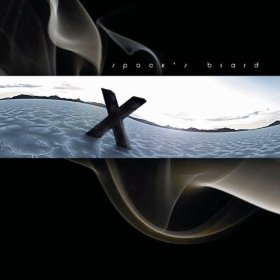
That makes it hard for Spock’s Beard, the international superstars from L.A. now in their eighteenth year, left standing as the proverbial prophets not accepted in their homeland.  Things seemed even bleaker in 2002 when frontman and brainfather Neal Morse departed from the group after six albums.  But now, with the release of X, the stalwart boys look to reclaim their crown as kings of the formerly-and-elsewhere-beloved genre.

Naturally, as their tenth album, X references their fifth: V.  Having run out their record deal last year, the band opted not to re-sign with any label just yet.  Instead, they funded and produced the album themselves and with the help of established friends in the industry.  Most of the money for the endeavor came from hopelessly devoted faithfuls like me who willingly shelled out up to $200 for various pre-ordering options offered before any recording took place.  Now that the finished piece of work is in our hands – 10 months later – was it worth it?

Ha.  “Worth it” would be an understatement.  This is the first post-Neal album that merits favorable comparisons to the band’s earlier work.  And that is the highest praise available.

Understand that this brand of prog comes with intricate time signatures, some eccentric keyboards, and long songs.  (The 8 tracks on X add up to over 78 minutes, near the capacity of an audio CD.)  Neal Morse was primarily a singing keyboardist, so, upon his departure, resident Moog master Ryo Okumoto attempted to maintain the key-centric attitude of the band to mixed results.  Drummer-cum-replacement-lead-singer Nick D’Virgilio then spent an album pretending he was a rock star before the guys managed to find their feet post-reconstruction.  This new album shows them gelling like never before and finding excellence as a fundamentally bass-driven band.

Two featured 16-minute tracks on the record are subdivided into movements.  Both “From the Darkness” and “Jaws of Heaven” are odd in that they forego the sort of blazing introductions or overtures that the band has historically employed to signal an incoming epic.  They hop right into things, the former beginning with a hard rock feel and the latter as a mournful western ballad.  At four movements apiece, though, the songs have plenty of time to pass through various moods and genres.

“From the Darkness” suffers slightly from a cut-and-jump approach to transitions that, while not disorienting in execution, leaves one feeling that they have just listened to four disconnected songs.  The abstract and vague lyrics (arguably a problem on half of X‘s tracks) don’t imbue any greater sense of unity in the story D’Virgilio spins.  Vastly superior in this regard is “Jaws of Heaven,” whose segues are fluid and whose movements feel related by recurring motives while each exhibits a unique musical character.  The third movement is particularly compelling: stirring far-off drums complement sparse guitar strokes and a soft voice, all held together by the persistent and understated bass.

Both suites conclude in powerful fashion.  Either would have been perfectly suited to end the album, an honor granted to “Jaws of Heaven.”

Four-stringer Dave Meros contributes his writing talents to “Edge of the In-Between,” a modest tune at 10 minutes long.  While not demarcated into sections, the song moves through a progression of passages with entrancing continuity.  The listener is never jilted by the undercurrents moving from a rollicking 4/4 chorus to an expansive 7/4 jam to a slowed-down bridge that alternates between dainty piano and sludgy bass.  The recapitulation that follows is reminiscent of the grand effect captured in “At the End of the Day” on V, a compliment not to be taken lightly.

Meros on bass and D’Virgilio on drums click so well that it’s easy to get the impression they are featured in every song on the album.  Soaring keys and crunching guitars are thus enabled to reach their full potential on every lick.

A strong case can be made that the standout track is “The Emperor’s Clothes,” nearly the shortest at under 6 minutes, beating out only the shifting and dramatic instrumental romp “Kamikaze.”  Written by guitarist Alan Morse (with added touches by his brother Neal!), it is a perfect example of great lyrics perfectly matched by effective musical arrangement.  The song tells the first half of the well-known story from the point of view of the tailor who has never sewn but has a plan to cash in: “Well you’ve never seen clothes / Like you won’t see those… ‘Cause the fabric’s so fine / It’s like it’s not even there.”

Bursting and driving trombones ring in the song and are later joined by french horns, a string quartet, and a number of wonky synthesized sounds to complement the core rock instrumentation.  Besides all this, there is a cheery a cappella section in the middle ended by a frenetic xylophone run.  Tempo jumps add to the effect of a song that is thoroughly fun.  Even the basic beat seems to recreate a circus parade!

Finally, a nod must be given to “Their Names Escape Me.”  The perfectly eerie mood created, so befitting of a song whose lyrics tell of a judgment and inquisition (“Tell us the names of every traitor who / Took up arms against the nation…”), continues and grows in tension as the band first sings the song proper, then moves into a list of names.  D’Virgilio captures in the tune my name and the names of every other contributor to the recording fund, all the while keeping legitimate music going underneath.  As the names are sung, the key raises steadily and the arrangement thickens until the eventual unearthly fade-out.

Led by Meros and D’Virgilio, with all intellectualism and virtuosity intact, X is a highly melodic and engaging product.  Finally, Spock’s Beard has recreated epics better than past efforts penned by Neal such as “Flow” and “The Good Don’t Last.”  Attempts to do so have been made on every record since his departure; only here have they paid off.  It is thrilling, after eighteen years, to see the boys raise the question of whether their greatest work lies behind them or ahead.


Apr 13 2010

Pleased to Meet You

Colton O.

Common courtesy! Here I’ve been yammering for months before properly introducing myself. Without a handshake or a how’s-your-father, I would have soapboxed myself to sleep while you smiled kindly. Please pardon me, good fellows and fellowesses.

This site’s authors have set a precedent of revealing their bias to their readers up front. I have not been so upfront. It’s time to pull back the curtain and subject myself to your personal evaluation. It’s time to be proper, if not punctual.

For your consideration, I present my top ten favorite albums:

1. Spock’s Beard – Snow (2002)

What follows will prove that only the magnum opus of a progressive rock genius could suitably head my list. Although Neal Morse has maintained a dedicated following in his post-Beard years churning out autobiographical and soteriological concept albums as a solo artist, this last of his efforts as the frontman of America’s uncontested lords of modern prog remains his most engaging. For nearly two hours, an organic and thoroughly melodic stream of hard rock, orchestras, and jazz fusion accompanies the operatic story of a mystically gifted albino in search of purpose. I would direct your focus to the extensive range of genres that are perfected over the course of the album and to the number of memorable climaxes achieved en route.

2. Gatsby’s American Dream – Volcano (2005)

In order to give everything away as fast as possible, my #2 is also a concept album. However, It is not a rock opera and it barely exceeds half an hour in playtime. Gatsby’s defining motive was a bitter urge to flip off the recording industry in everything they did. Their abrasive demeanor and standard-fare equipment belie musicality that is beyond daring: it’s more like they don’t even care. They rush like fools into a world of metric modulations, 30-second songs, and 3-minute songs that rewrite themselves every 30 seconds, usually rejecting the suggestion of a chorus. This is the kind of music whitewater rapids would listen to. On Volcano, Gatsby’s loads that style with interconnected lyrics that spend the 13 tracks integrating Lord of the Flies with the story of Pompeii, with myriad easter-egg references sprinkled on top spanning at least literature, gaming culture, and, of course, the big bad music industry.

3. Liquid Tension Experiment – s/t (1998)

If you’re still wondering what I meant by “progressive rock” earlier, I don’t have space to explain it now. Think Pink Floyd or Kansas. If you only know one modern prog group, it’s probably Dream Theater. Magna Carta records offered Dream Theater’s drummer, Mike Portnoy, the chance to construct his very own dream-team supergroup. The result, Liquid Tension Experiment, is simply the most dense collection of virtuosity our planet could support. While indulgent jams dominate the follow-up, this initial release primarily features fully composed and arranged works… all worked up from scratch to final product in less than two weeks. LTE is purely instrumental. And if instruments can speak, then this is Ciceronian oration.

4. Pelican – Australasia (2003)

Another genre I must leave unexplained is post-rock. If you’ve heard of Tortoise, Mogwai, or Godspeed You! Black Emperor, think of them; if not, look up Sigur Rós or Explosions in the Sky. Sift out any remaining vocals and stir in the heaviness of drone metal, then stick it in the oven and let it bake your brain for about 11 minutes. Regroup for track 2. Pelican has received criticism for deficient drumming and is commonly held to be a lesser version of their niche’s fairy godfathers, Isis. But I find that Pelican’s simple and direct approach lends them a purity that makes it look like other bands are just trying too hard. Australasia seems comfortable in its emotions, as though these guitars are on a first name basis with calmness and tension alike.

5. The Rocket Summer – Hello, Good Friend (2005)

Surprise! A departure from the experimental and exploratory artists above, The Rocket Summer is one kid from Texas with a backpack full of jangly pop tunes about how wonderful life is. It’s true! So what am I, an apparent artsy progger, doing cheering for Island Def Jam’s premier church-going heartthrob for preteen girls? Bryce Avary is a musician of no suspect merit who performed every instrument in studio for his first two albums. When a band’s primary songwriter is a bassist, they tend to have sick bass features. When a band’s primary songwriter plays everything, every musical line gets infused with motion and intent. Layering of concurrently meaningful harmonies elevates The Rocket Summer beyond fields of alt-rock peers, and the undiluted joy in Avary’s still-maturing voice sends me to heaven.

6. Junction 18 – This Vicious Cycle (2000)

If you check the band’s extant MySpace, you might find this to be another stumper. More likely, you’re going to identify Junction 18 as my prized pet band, and I won’t dissuade you. Here we have four guys who never made a second full-length and barely toured outside of Massachusetts. They sound like any emo band from the recent peak of that insult’s popularity. My devotion is tied to their execution of a linear songwriting ethic in a genre that never heard of such a thing. By linear, I mean that choruses, when used, demarcate verses that each have their own character. Putting a different lyrical stanza to the same tune is common. Changing the underlying melodies, chord progressions, and structures of the song with each passing minute creates an experience of continued forward motion that sweeps out a coherent musical story arc.

7. Rx Bandits – …And the Battle Begun (2006)

“Ska” is a term I pray you’ve already met in some form. By convention, ska is analyzed into three waves (so far), and the Rx Bandits have a few toes dipped in each with two arms reaching for the sky. Reggae and jazz pervade the savvy rhythms of these impassioned rockers. …And the Battle Begun has its finest moments accentuated by horns, which were sadly absent from their more recent sixth release. A live recording process here ensured two things: that all of the Bandits’ energy would survive production; and that said energy would be multiplied through positive feedback between bandmates, all in one room, letting loose on jams and shout choruses. Recurrent themes and deadeye transitions add a transcendent character to this thoroughly visceral masterpiece.

8. The Cardigans – First Band on the Moon (1996)

I’m a sucker for Nina Persson’s voice. But I don’t follow The Cardigans just because that coy alto purr sends me into a fanboy daydream. Guitarist Peter Svensson has bona fide songwriting chops – and an appetite for metal, wonderfully enough, which is why a cover of Iron Man comes two tracks after Lovefool. (Lovefool is the one song you know by the Cardigans: “Love me, love me, say that you love me….”)  Later absorbed into Universal Music Group, Stockholm Records released First Band on the Moon while still an independent label willing to give some future notables from Sweden the chance to do their own thing. Amidst the gamut run by the Cardigans discography, First Band on the Moon ranks as the most oddball (in a cute way) of the pop. The arrangements are unexpected and full of zest, with bunches of instruments used, only a few at any given time, and not a single one out of place.

9. The Dissociatives – s/t (2004)

The irradiated rock generated by this assembly of quasi-famous Australians features all the harmony and vibrance you could want. It also features the “surreal for the kidz” choir, a handful of “dub freakouts,” and a guy credited on one track for playing “ice bucket.” Vocals that are both warbly and choppy blend in with an alien soundscape of blips, whirrs, and crashes. And yet the organic whole punctually plots out verses and choruses like beaten paths in a foreign land. If you’re scared, know that all the creatures surrounding you in the world The Dissociatives create are smiling and singing along. Evidently, the originality of this album defies description. More shocking still is the extreme catchiness of the melody that is the fallout.

10. Guster – Lost and Gone Forever (1999)

More than any other artist on this list, Guster might come off as plain. One of many indie success stories, another college rock band that outgrew the underground, these eco-friendly Jews now float along the mainstream between the sloping coasts of “alternative” and “adult contemporary.” But I would blindly recommend Guster to anybody seeking good music. Their consistent aesthetic appeals equally to fans of bubblegum pop, who get dominant hooks thickened by vocal harmonizing, and seekers of invention, who get uncommon teflon rhythms from Brian Rosenworcel. Universal appeal is as indisputable a reason as any to be ranked among the best.

(Get it? They’re “teflon” rhythms because they’re “stick-free!”)


Mar 8 2010

Transatlantic: Supergroup Spotlight

Colton O.

Well I guess it began towards the end of 1996 when I received a call from [head of Magna Carta Records] Pete Morticelli and [head of Shrapnel Records] Mike Varney who wanted to put together a couple of “Super Groups” (for lack of a better term!).  One turned into the Black Light Syndrome project with [Frank Zappa drummer] Terry Bozzio and they asked me if I’d like to help construct the other….

So… They asked me to compile a “Wish List” of all the musicians I’ve always wanted to work with.  With Frank Zappa and John Lennon no longer being options, I came up with some other names.

These words were taken from the liner notes of the self-titled debut album by Liquid Tension Experiment, whose eventual lineup consisted of drummer Mike Portnoy (the author of the notes), bassist Tony Levin, guitarist John Petrucci, and Jordan Rudess on keys.  With no clear frontman and no vocalist in sight, this all-star prog rock dream team laid down some of the most fluid, engaging, virtuosic instrumentals ever unleashed.

They will be remembered as Mike Portnoy’s second-best supergroup.

Before the turn of the century, in fact, Portnoy worked with multi-instrumentalist Neal Morse to assemble Transatlantic: the contemporary equivalent of Asia, the grown-up future selves of A Perfect Circle, the prog rock version of… I don’t know, Chickenfoot.  Let me introduce the cast.

Mike Portnoy of Dream Theater is the premier living prog metal drummer.  What he lacks in jazz chops – and I say “lacks” only relative to the absolute greats – he proves unimportant through the inimitable crossover success of his primary project.

Neal Morse, now a solo Christian artist with a string of religious concept albums under his belt, rose to international fame as the mastermind behind Spock’s Beard, America’s answer to Genesis, founded in the 1990′s.

Roine Stolt, Sweden’s gift to prog, has achieved greatness foremost with The Flower Kings with his songwriting and lyrical prowess.  His work on guitar, no less, brings to mind a young Steve Howe.

Pete Trewavas has played bass for Marillion ever since Fish was there… which is a statement I encourage you to investigate on your own if its gravity is lost on you.

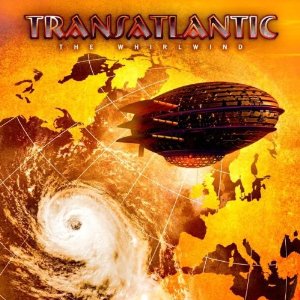
These accolades are leading somewhere, I assure you.  Transatlantic congregated for a week or two to throw together a brilliant masterpiece in each 2000 and 2001.  Almost a decade later, these musical giants of our day have graced us with one more taste of teamwork, entitled The Whirlwind.

As we should expect, Transatlantic used up just about every second of the 80 minutes a mass-produced cd can hold, filling that space with one continuous piece of music demarcated into twelve thematic tracks.  All four guys bring their own sounds to the table and everybody can be heard singing lead at some point or another.

A seven-minute instrumental overture gives way to the bookend motif “Whirlwind,” which lyrically sets the stage for tales of life’s oppressive confusion and how we can overcome it.  Soon after, “On the Prowl” lays down the sickest jam you ever did hear.  Killer drum licks pair with a genius jazz bassline to hold the ground while Stolt’s guitar and Morse’s keys take to the sky, cruising through a wild array of styles and rhythms with adept elegance.  That solo session stands as a clinic on how to show off technical ability while remaining genuinely melodic and engaging, all off the top of your head.

Expansive vocal harmonies draw your attention in “Out of the Night” while the striking guitar commands your toes to tap.  It is one of many tunes to evidently showcase team songwriting – in fact, this is true of every song on the disc.  Influences from Spock’s Beard and The Flower Kings take turns directing the overarching mood of each passage while Trewavas and Portnoy invent whatever ideal companion of an undercurrent they’d like to produce at any given time.

In truth, there isn’t much Dream Theater to be heard here.  Portnoy’s brand of rock is an outlier next to relative poppiness around him in Transatlantic.  However, in “Is This Really Happening?”, the metal beast is freed and a sonic onslaught of punishing rolls and blast beats coerces Stolt into some serious dark shredding.

Only one standalone instrumental was written for the album, “Pieces of Heaven,” and though it is shorter than one might have expected, each of the other songs contains a host of solos and constructed melodies enacted sans vocals.

Just before the reprise of the bookend motif, Neal Morse slips in some of his least obscured religious undertones in “Dancing with Eternal Glory.”  That man is a singing preacher at heart who has no reserves about his evangelical calling.

The Whirlwind closes with every bit of grand majesty becoming of a progressive concept album.  If anything, I was surprised that equal magnificence and pomp did not decorate the first few minutes of the overture, but the greatest swell was saved for last.

So as to provide some small facade of objectivism, let me critique the performance of all four musicians on this album in the department of vocal performance.  Neither Stolt nor Morse, who split the major part of the singing duties, will ever win an award for having a pretty voice.  Certainly both are capable, but with unspectacular ranges and what some might call an elderly tremolo to their sound.  Trewavas and Portnoy are nothing if not unremarkable vocally.

The music in The Whirlwind is at times technically extreme and often improvised or elaborated.  What will be far more salient to non-proggers is that the songs are long and, from a mainstream standpoint, circuitous.  Verses and choruses together make up only half of the 80 minutes, a fact which can leave unfocused listeners feeling lost.  This is all a matter of the target audience: some people find Transatlantic cumbersome in style while others see them as monoliths of ability.  Fortunately, those who have cause to stumble upon the group tend to fall into the latter set.

Mike Portnoy’s “Wish List” of musicians didn’t include a single vocalist.  Yet a couple of years down the road he and Pete Trewavas joined two frontmen to form a powerhouse collective of prog’s most famous standard bearers into the new millenium.  Any predictions for who will be part of his next collaboration?