

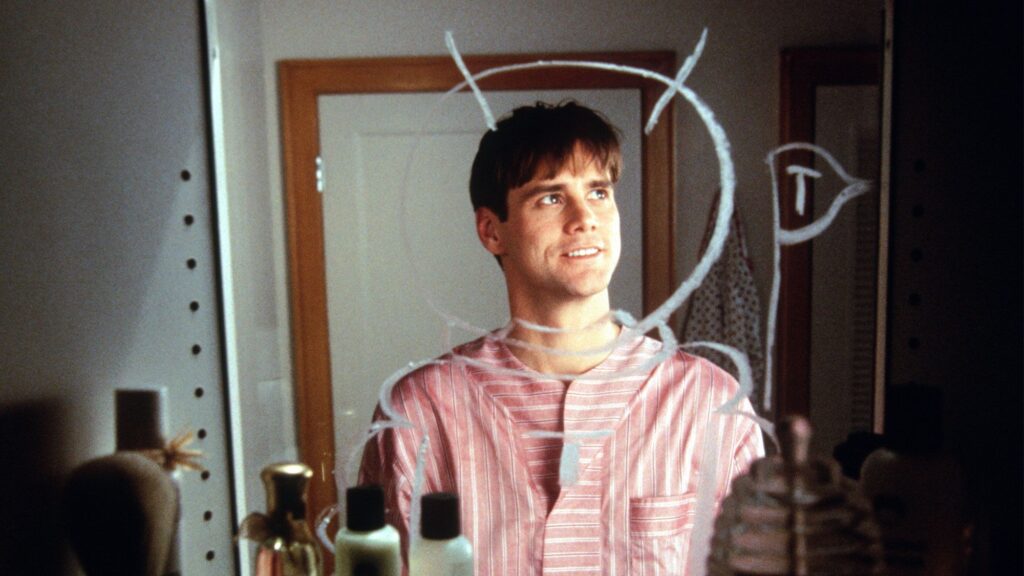
The Truman Show is astoundingly great cinema, in part because it’s so much weirder than it needs to be. The premise alone, of a man’s entire life filmed and broadcast to millions from birth without his knowledge, is a tremendous hook to get you in the door, but a wide open one. It would be easy to adopt a clear and coherent take on the material with something like a sleek mystery-thriller or a teary melodrama, and end up with something great. But Andrew Niccol’s screenplay and Peter Weir’s direction refuse a simple take at almost every turn, even as they keep the tone lightweight. Instead, they linger in the contradictions, the strange textures, the tough questions about the stories we tell about ourselves. It’s a masterpiece with rough edges, and those quirks are a big part of the magic.
We meet Truman Burbank (Jim Carrey), who is the most boring guy you’ve ever met, interesting only due to his exposure. His prefabricated reality takes place in a fake town called Seahaven, which is all clean lawns, the chipper neighbors, the office job. On the surface, it’s not all that different from mundane American suburbia, fake as it is, which is the joke, of course. The line between a manufactured life and an authentic one is not just thin but unknowlable, and it cuts at the very core of the stories we tell about ourselves. Truman is Adam in his garden and Noah on his boat and Jesus ascending to the heaves. He’s also a weirdo with cartoonish neuroses bursting out of his limbs, because he is, after all, being played by Jim Carrey, whose elastic physicality here becomes a kind of argument for the soul trapped inside a sitcom body. Carrey plays a man on the verge of losing his mind, and part of the thrill is the suspicion that some of the insanity is hardwired into the performer, leaking through the character like light through a crack in the set.
And Weir is taking every visual swing he can to make the ideas stick. The film is a formal specimen as much as a narrative one. Relentless telephoto lenses compress Truman’s world into a claustrophobic flatness; irising and simulated security-camera angles constantly remind you that this reality is mediated, observed, owned. Meanwhile, the production offices where Christof (Ed Harris) orchestrates Truman’s life are rendered with freakish expressionism — a mad science lab perched on a fake moon, screens the size of a John Ford horizon, byzantine gadgetry and Metropolis-scaled autocratic infrastructure filling every frame of the “studio.” Harris plays the creator-god figure with chilling gentleness, a man who has confused control for love and surveillance for care. The contrast between his sleek lunar command center and Truman’s pastel-washed suburbia is, visually and thematically, one of the richest dualities in late-’90s cinema.
The film suggests some truly frightening ideas about the commodification of the human experience and the surrender of personhood to capitalism. Laura Linney’s and Noah Emmerich’s characters — Truman’s “wife” and “best friend,” respectively — deliver blatant product placement mid-conversation, and it barely feels unnatural, which is exactly the point. The Truman Show predicted reality television, yes, but in 2026 it reads even more clearly as a prophecy about social media: every life a broadcast, every moment content, every human connection potentially a transaction. And yet, for all of that thematic weight, the film generally has the texture of a fun caper. It’s a movie that manages to be simultaneously terrifying and buoyant.
The story could have explored a hundred different angles; I’d love to see a version that follows an extra or a stagehand, someone forced to build their entire existence around the whims and routines of a single oblivious guy. But Weir and Niccol chose the most direct and challenging one: the story of a “true man,” the center of all the commotion, whose craving for freedom and knowledge becomes a spiritual epic as much as a dystopian satire. Truman walking up those stairs and through that door in the sky is one of cinema’s great transcendent moments, simultaneously funny and devastating, silly and sacred. A total, undeniably peculiar, masterpiece.
Rating: **** (out of 4)


