
Apr 6 2010

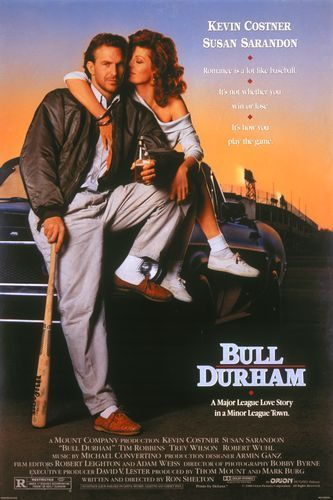
Bull Durham: Just call it the best and move on

Grant J.

Bull Durham

Rating: 4 stars (out of 4)

Bull Durham is far and away the best sports movie of all-time, but I hate to classify it as much because it’s also so much more.  It’s a great romantic comedy, a very funny movie, a very poignant movie, and when all put together, an exceptional piece of art.  Refusing to conform to anyone else’s conventions, consistently surprising with its charm and inventiveness, and brilliantly written and acted, it only gets better with repeated viewings.

Written and directed by a man who spent many years in the minor leagues himself (Ron Shelton), Durham centers on the single-A baseball team of the Durham Bulls.  Their star pitcher is Ebby Calvin “Nuke” Laloosh (Tim Robbins), whose velocity can match the best of them but who often has little control over where his pitches are going.  A talented but aging minor league veteran, Crash Davis (Kevin Costner), is brought on to be Nuke’s personal catcher and prepare him for the majors.  With one man destined for potential stardom and another hoping that single-A ball suffices as a replacement for such, one possessing great physical gifts and one intellect, the two have a complicated friendship, and Annie Savoy (Susan Sarandon) spices it up even more.

Annie is a baseball nut who chooses one player a year to sleep with, which said player generally follows with the best season of his life.  Sarandon has many scenes with both Robbins and Costner, and the sexual attraction between both pairings, especially with Costner, sizzles.  Annie’s sexualized, to be sure, but she has her principles—“I am, within the framework of the baseball season,” she tells Crash, “monogamous.”  She also has other loves, in particular poetry, which she reads to guys foolish enough to think they might sleep with her on the first night.

As incendiary as the romance is here, the baseball scenes are better.  Nuke sets new league records for strikeouts, walks, hit basemen, and hit mascots in a game.  There’s not a single pitcher in a baseball movie with great velocity and poor command—Wild Thing, anyone?—not modeled after Nuke.  But Shelton doesn’t make him out to be a clown—he’s just a young buck who, as Annie notes, is not cursed with self-awareness.  When he ignores Crash’s advice or slacks off in his game preparation, it’s only because he doesn’t know better, not because he’s trying to make noise.  Robbins’s ability to make him so childlike and yet believable is particularly impressive.

Though Crash and Nuke meet via a bar fight, they settle down, and their interactions drive the film.  Crash ends a fight by telling Nuke to hit him in the chest with a baseball from 15 feet, which he can’t do once he starts to think about it.  “Don’t think,” Crash tells him.  “It can only hurt the ballclub.”  On the field, Nuke has an unfortunate habit of shaking off Crash’s pitches, which invariably results in a home run.  Robbins’ “You told him I was gonna throw the deuce, didn’t you?” after the second tipped pitch is priceless.

With just these components, Bull Durham would be a winner, but the film’s gravity and intelligence sneaks up on you; only by the end may you realize what a serious film it really is.  Note, first off, how Shelton eschews all sports clichés.  The Bulls never bond together to win anything.  No struggling player saves the day at the end, and the manager proffers no long-winded inspirational speeches.  The film, rather, opens our eyes to the often contradictory world of minor league ball, with players who may spend their entire careers there, hoping for a shot at the big leagues, enduring the lengthy bus rides and few fans and small compensation because they love to play.  When Crash recalls his three-week stint in the majors earlier in his career, the other players listen in awe, as though he’s speaking of a priceless jewel that they will never find.

I could write pages and pages listing every great scene in this movie and commenting on the pitch-perfect tone that the actors strike.  There are Crash’s mound conversations with Nuke (“Strikeouts are boring; besides, they’re fascist.  Throw some more ground balls, it’s more democratic.”), his accusations (“You don’t respect yourself, which is your problem.  But you don’t respect the game, and that’s mine.”) subtle teachings (a rant about shower shoes effortlessly illustrates the differences between the two), his rising sexual tension with Annie (“You know, having a conversation with you is like a Martian talking to a fungo”), and on and on.  In almost every scene, I can identify a place where it could have gone off track, where a lesser writer would have taken it, and I’m constantly impressed, no matter how many times I’ve seen it, with Shelton’s touch.

The film’s final act is contemplative and almost somber, as Crash works out his problems for good with both Annie and Nuke.  Though Nuke and Annie are more vibrant and Robbins and Sarandon are lightning in a bottle, Crash is the film’s heart and soul, the character with whom Shelton clearly identifies.  In particular, his philosophy comes out in an exquisite scene at a bar when Nuke wants him to celebrate his promotion to the minors.  When Crash talks about the vagaries of the game and then asks Nuke, “You still don’t know what I’m talking about?” he knows that, at the very least, he does, and that’s enough to keep him coming back.


Apr 3 2010

Major League: Not quite, but good enough

Grant J.

Opening Day for the 2010 baseball season approaches, so let’s revisit one of the more popular baseball flicks out there.  Flawed, but a must-watch for any fan.

Major League

Rating: 2 and a half stars (out of 4)

Major League doesn’t treat baseball with the same reverence that Bull Durham or Field of Dreams (or, for that matter, For Love of the Game) does, but it celebrates the quirkiness of those who play it.  It embraces the oddities and idiosyncrasies of a group of players on a makeshift Cleveland Indians team, faltering only when it diverts from that path and devolves into a soppy love story.

The owner of the Indians, Ms. Phelps (Rachel Whitton) notices the team’s sagging attendance and decides to employ a most unusual strategy: because she can move the team to Florida if crowds drop below 10,000 a game, she wants to put the worst possible product on the field.  To that end, she wipes the roster clean and invites a bunch of has-beens and never-weres the fans have never heard of to training camp: Jake Taylor (Tom Berenger), a broken down catcher; Roger Dorn (Corbin Bernsen), a self-obsessed third baseman with a decent bat and a glove made for a designated hitter; Pedro Cerrano (Dennis Haysbert), a voodoo-preaching defector from Cuba who devours fastballs and flails at anything else; Rick Vaughn (Charlie Sheen), who spent last season in the California Penal League; and Willie Mays Hayes (Wesley Snipes), who in his attempts to impersonate his namesake spends his spring training doing push-ups for trying—and failing—to hit every pitch he sees out of the park.

As is customary with comedies, the best and funniest scenes occur in its first half, as it follows these oddballs through spring training and the beginning of their season.  I can’t help but crack up when I see Willie’s bed carted out onto the field in the middle of the night as punishment for showing up to camp uninvited, or when Vaughn takes the mound for the first time minus critical pieces of his uniform. (“We wear caps and sleeves at this level, son!”) When Dorn barely flinches at a groundball that goes past him, the manager tells him he’ll be joining Willie in physical education exercises with sit-ups, prompting Dorn to insist that his contract specifies that he’s not required to perform any calisthenics with which he’s not comfortable.

Pedro, however, is by far the most memorable character, whether he’s antagonizing a straight-arrow Christian teammate with his religious practices, demanding a live chicken be killed in order to break a curse (even though this does ape Bull Durham, which required the dismemberment of a live rooster for such a purpose), or hopelessly whiffing on curveballs.  (He’s also the only one to survive the painful follow-up, Major League 2.) Props too for Bob Eucker’s announcer, who has memorable fun at the team’s expense.  Early on, he peruses a box score and bemoans, “One hit?  That’s all we got, one godammned hit?” and re-assures his partner that the tirade won’t cause problems because “no one’s listening anyway.”  Later, when they start winning: “In case you haven’t noticed—and judging from the attendance, you haven’t—the Indians have started to win a few.”

The problem with this movie is that it runs out of steam about halfway through, as do a lot of decent comedies (Wedding Crashers, anyone?).  Not knowing what to do, it reverts to familiar clichés: an underdog team that starts to win and believe in itself and a paper-thin love story you wouldn’t read to your dog.  The latter features Jake’s attempts to win back an ex-flame (Rene Russo) he sees at a restaurant one day.  All of these scenes are cringe-inducing, and it’s hard to not point out the narrative flaws.  She swears that she’s marrying someone else and tells him to bug off, and then, boom, she attends a game, after which he follows her home and they sleep together.  Once that’s out of the way, obviously the fiancée is too, and everyone can go home happy.  Right.  Just not the viewers.

Similarly, when the team begins to win, things get much less interesting.  I’d much rather see Rick Vaughn plunking a guy after serving up a first-pitch grand slam after three consecutive walks than him striking out the side, especially when Indian victories mean the typical montage of inspired play (set to music, of course) that’s been around the block too much.  Fortunately, the movie stays afloat when Ms. Phelps, fed up with the winning, makes their lives more and more uncomfortable—first to go are the jets (they take a bus to games in the spirit of minor leaguers), then the hot water in the locker room, and any other convenience she can deem a needless luxury.  Sadly for her, though she can try to make her team bush-league, they play better with someone to root against; the movie’s most famous image involves them placing a statue of her in the locker room and removing one piece of her clothing for every win that puts them closer to the playoffs.

Because this movie isn’t as serious or intelligent as the aforementioned, it will never be ranked high in the pantheon of baseball movies, especially considering its dramatic flaws.  Despite certain segments excelling, the turgid second half submerges it.  But it takes a light-hearted approach to baseball and provides some hilarious moments without ever crossing the line and making the game a farce, which it could easily have done.  In April or October, watch Bull Durham or Field of Dreams.  In February, watch Major League.


Jan 30 2010

Blind Side: What are the real parts again?

Grant J.

blind side

Rating: 1 star (out of 4)

Hollywood studios like to propagate the idea that romantic comedies are suitable for both men and women.  Blind Side isn’t a rom-com, but doubtless this idea still came to them—hey, let’s combine Sandra Bullock (the women) and football (the men) to draw in maximum viewers.  Add the holiday season and a feel-good true story and you’ve got yourself a sure box office winner.

And, indeed, Blind Side has, along with The Proposal (and, I suppose, All About Eve) helped make 2009 the best box-office year of Bullock’s career, which must make the ineptitude of these films forgivable to those in the suits.  In this true story adaptation, Bullock plays Leigh Anne Tuohy, a Memphis socialite living the good life, thanks largely to the fact that her husband Sean (Tim McGraw) owns 85 Taco Bells.  She takes an interest in a student who was recently admitted to their kids’ private Christian academy, the imposing football player Michael Oher (newcomer Quinton Aaron). 

Michael’s life reads like a fairly typical sob story—crack-addled mother, no father, never been educated properly—but despite that and his overwhelming size, he’s calm and polite.  Leigh Anne takes him under her wing (and roof) and helps him hone his football skills, helping him ultimately go on to receive a college scholarship and a first-round draft pick of the Baltimore Ravens.  An interesting story, but, sadly, in telling it, director and writer John Lee Hancock utilizes all of the clichés and wooden characters that surrounded his last sports flick, The Rookie.

Is anything real or believable in this movie?  Certainly not Michael’s first night in Leigh Anne’s house, where she plops him on the couch because the guest room has boxes in it; please, woman, that house has five guest rooms.  And not the football scenes, which hit perhaps a new low for Hollywood.  The film apparently wants us to believe that one excruciating scene of Leigh Anne playing coach for a few minutes qualifies as Michael being taught how to play; of course, there’s a lot more to playing lineman than size, but oh well.  I guess that’s not important in a movie that wants you to believe that one good block means the running back can saunter in from 70 yards away for a touchdown, or that referees really wouldn’t be able to come up with a penalty for shoving someone over the field boundary (it’s called unnecessary roughness, guys).  

And it doesn’t help that Michael’s coach (Ray McKinnon), uh, isn’t exactly Billy Bob Thornton or Denzel Washington.  He’s not a good enough actor to make us understand that, when he sincerely pitches Michael’s school admission to the deans, he’s furtively concerned about his own team’s success.  (We assume that to be the case, independent of his acting, but when including the acting we’re just confused.)  He has plenty of company, though, as good acting is hard to be found here.  As laconic Michael, Aaron is fine, but McGraw and Bullock can’t find any kind of true emotions.  McGraw looks like someone behind the camera is giving him instructions at all times (where is the talent from Friday Night Lights?), and I can’t for the life of me figure out why so many critics are calling Bullock’s performance her career best.  I often like her, but this may be the worst I’ve ever seen.  In her attempt to break away from her breezy roles and look “solemn” or “serious,” she transforms herself into an utter statue, completely lacking in human emotion or realism.  She looks awkward in just about every scene, as though she’s reading the words for the first time.

McGraw and Bullock certainly aren’t helped by a script that paints the family dynamic in unrealistic and annoying ways.  The writers think they can show spousal love with vague, bland irritations—the ‘I can’t stand how she does this, but that’s why I love her’ nuisances common to such films—and they introduce yet another annoying little kid.  Jae Head’s young SJ almost manages to attain the mind-blowingly irritating level of Hayden Panettiere in Remember the Titans.  (Largely because of this, it was to my immense relief that Leigh Anne’s daughter wasn’t a typically “angsty” Hollywood teenager.)

And the script also makes a mockery out of painful stereotypes—both black (everyone in the ‘projects’ where Michael’s mom lives) and white (heartless rich bitches that Leigh Anne lunches with).  That’s in between its presentation of such bon mots as “You’re changing his life”—“No, he’s changing mine” and Michael’s groan-inducing, predictable-but-unbelievable “Don’t lie to me” retort to Leigh Anne.  In your face, woman!

Amidst all this, the plot is a mess, going fully sideways after what feels like the climax into an utterly unnecessary final scene with Michael at the projects, topped in absurdity only by Leigh Anne going back there—disregarding Michael’s earlier words of caution by wearing a ridiculously provocative dress—and getting in the face of one of the thugs in a move that makes you want to throw something at the screen.  Such moments are particularly troubling because they seem to be replacing what might have been meaningful scenes: by the end, one wonders why no more mention was ever made of Michael’s briefly seen brother or his mother—did he never say anything about them as he was preparing to attend college?

It’s remarkable that this movie needs more scenes, given that there are so many gratuitous ones that bloat the running time.  Most movies of this ilk last—as they should—about 90 minutes, yet, for reasons passing understanding, Blind Side runs two-and-a-quarter hours—but then again, most everything about this movie was done for reasons passing understanding.


Jan 28 2010

Invictus: No sense of the moment

Grant J.

invictus

Rating: 2 and a half stars (out of 4)

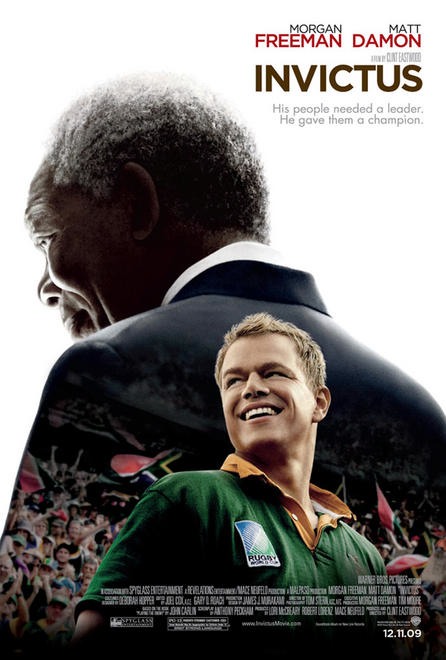
For those who have seen the trailers and are reasonably familiar with the puppets behind the stage, Invictus will probably be much like what you expect.  Clint Eastwood’s directorial style—at best, smooth and undistracted, at worst flat—Morgan Freeman and Matt Damon’s dignified acting, and a stirring finish are all delivered as expected.  But although Invictus is certainly safe in its own way, it’s not at all the kind of movie one might have expected about Nelson Mandela…nor is it nearly as good as it could have been.  This film centering around the famous president of South Africa, elected after spending 27 years in prison, doesn’t delve into his incarceration, The Hurricane-style, or tell a birth-to-present biographical story complete with cries from his estranged family members.  Instead, it possesses many hallmarks of a classic sports movie, replete with an underdog we can cheer for and a ceremonial ending.

At the movie’s outset, Mandela (Freeman) has been recently elected president of South Africa, a country in tatters and still filled with racial strife.  Blacks are pleased with his election but skeptical of Whites and of the possibility of actual change; meanwhile, Whites wonder whether their dominance will be stripped away.  Mandela starts by surprising the Whites on his staff by telling them they won’t be fired, then begins contemplating how to start unifying his country.  He cares not about revenge but rather wants whatever will help his country heal fastest.  And to that end, he turns to rugby.

Captained by Francois Pienaar (Damon), the national rugby team, the Springboks, have long been ignored or condemned by the country’s Black population.  Playing a largely White sport (as opposed to soccer), the Springboks have represented apartheid for years.  Blacks want the team and its colors disbanded, but Mandela sees a different angle: he wants the country to rally around its team in the upcoming Rugby World Cup.  Mandela, shrewdly, seems to sense the transcendent power that sports victories have for people, and he envisions a winning Springboks team as a potential beacon of inspiration for his countrymen, regardless of their skin color.

Eastwood and writer Anthony Peckham carry much of the film with grace and effective understatement.  But given their decision to focus so much on sports—and rugby, no less—and not the historical figure, their inability to generate the proper gravity of the climactic game has to be considered a damaging flaw.  That this rugby team, considered a laughingstock before the Cup, actually managed to come together and win after Mandela encouraged them to do so is mind-boggling—the kind of thing that would be laughed out of the cutting room floor of a proposed fictional tale.  Invictus, sadly, imparts absolutely no sense of the moment, of the magnitude of the success.  Not only is there no explanation of how the team improved or of how improbable that was, the film, and its climax, doesn’t feel nearly as ‘big’ as it should.   

What’s more, we don’t know anything about any players (including Damon’s) or, let’s face it, the sport itself; so, with all that combined, we watch the final game in a sort of blank numbness.  Since that game lasts about twenty minutes—and since the escalation of the team’s skill accounts for most of the film’s latter half—that severely hampers our ease at fully enjoying the proceedings. 

Invictus deserves credit for adding in a few mischievous lines for Mandela to keep him from merely being a boring saint, but other small details are botched.  We don’t need the awkward quasi-hug between the antagonists-turned-somehow-friends after the winning game (an irritating sports movie cliché), or the astoundingly predictable sequence involving a young Black kid and police officers during the game, to which Eastwood cuts back too many times. 

Surprisingly for a movie that takes its obscure Latin title from the William Ernest Henley poem from which Mandela drew strength while in jail, Invictus is nothing more than a conventional sports movie.  There’s more about Mandela that’s interesting, obviously, but they chose to go in a different direction.  Greatest credit should go to the actors, especially Damon, who nails his limited role and accent (there’s a locker room scene where he delivers an anti-inspirational speech with such restraint and focus it’s a shame it only lasts for a couple minutes).  But otherwise, it’s a safe movie, a relatively competent one, and a relatively frustrating one.


Sep 4 2009

Friday Night Lights: Football, not life

Grant J.

September has arrived, and the weather seems to be starting to cool down, which means that it’s finally time for some football.  High schools are the first to start playing (there’s still another agonizing week before the NFL season kicks off), so this Friday is a perfect time to highlight the best football movie that I’ve ever seen.  Let the games begin…

Rating: three 1/2 stars (out of four)

“When you’re famous at 18, you spend the rest of your life fading away.”

The lead character of John Grisham’s delightful novella Bleachers spoke those words, and they apply perfectly to the attitudes explored in Friday Night Lights, which concerns the same material as that book: high school football.  This time, the focus is on not only the team but also the suffocating culture that surrounds it.  Based on H.G. Bissinger’s book chronicling the 1988 season of the Permian Panthers of Odessa, Texas, Lights excels with traits that rarely come with football movies.  Indeed, it’s hardly a sports movie at all (just like how the Bournes are much more than spy flicks) but rather a realistic, emotive, beautifully-acted film that’s about the lives of its characters.  Although the yawningly overwrought description on the back cover doesn’t reflect it, the film cares about a lot more than the success of its team.

The movie is unflinching in its depiction of the town.  Director Peter Berg uses washed-out colors to make the landscape look even more barren, helping us to at least partially understand why everyone you meet is so obsessed with the only thing that gives their area fame.  The Panthers are the winningest high school team in Texas history, with four state championships to their name, but that matters little in the what-have-you-done-for-me-lately culture.  Football is the easiest way to make someone in Odessa happy, yet because of the way the town approaches it, it collectively sucks all the joy out of it.  Note the grim expression on the face of quarterback Mike Winchell (Lucas Black) when college recruiters tell him the game is supposed to be fun.  Media frenzies surround the first practice of summer, and when the father of a player (played by Tim McGraw) comes out onto the field to castigate him for fumbling, people stare, but no one stops him.  Eventually, a player steps in to say, “Please…it’s the first day of practice,” as if to say that such an outburst would be permissible when the team was supposed to be in mid-season form.

Most sports movies are by definition ensemble pieces, but there’s generally a hero to root for, namely the coach or quarterback.  Lights is even more egalitarian—no one could be considered the star.  The movie focuses mostly on third-year coach Gary Gaines (Billy Bob Thornton), Winchell, star running back Boobie Miles (Derek Luke), and fullback Don Billingsley (Garrett Hedlund), and it almost sneaks up on you in the way it fully develops its storylines with grace and intelligence.  Billinsgley, for example, has to deal with his abusive father, still living his life based on his high school glory days.  When Don keeps fumbling, his father takes out the anger that stems from his dead-end life on him.  But he isn’t the devil, just a misguided, alcoholic man who’s been burned out by life—who’s been fading away since 18—and assumes that the same will happen to his son after high school.  McGraw subsumes himself into the role and delivers a heart-wrenching performance.

FNL simply excels in its depiction of the characters’ struggles with holding onto any measure of joy amidst the despairing situation in which they live.  Black, an asset in All the Pretty Horses, effectively presents a hesitant quarterback who isn’t sure he wants to leave the town because of his mother’s ill health.  Boobie, excellently played by Luke, carries not only the expectations of the town but also the burden of being the team’s centerpiece.  He’s effectively lost for the season to injury in the first game, yet he and his uncle do all they can to avoid listening to doctors.  There’s an emotionally stunning scene when he sits in a car after clearing out his locker and realizes that he has never planned on a life that doesn’t include football.

Thornton’s coach regards the football obsession with a bit of bemusement, as he understands that a loss isn’t the end of a pursuit of happiness.  He is an atypical movie coach, neither a tough guy in the mold of Denzel Washington’s character in Remember the Titans nor a “players’ coach.”  Thornton, whose performance is the epitome of controlled yet evocative acting, says more with his eyes than words, but Gaines does give the Panthers the best speech I’ve ever heard in a sports movie.  At halftime of the state championship, knowing that the game represents the end of the football era of his players’ lives, he doesn’t try to make them believe they can do anything.  He just says, “Put each other in your hearts forever, because forever’s about to happen out here in a few minutes.”

How refreshing it is to reach the final scenes of a sports movie and be concerned with things other than a game’s outcome.  Panther wins don’t generate much emotion–they’re expected and accepted, but not experienced the way losses are.  Thus, if you understand by the end that Friday Night Lights has nobler goals than most sports movies, you won’t find the conclusion surprising.  And just as a critical mid-season loss leads to important conversations between Gaines and Winchell and Billingsley and his father, the climactic heartbreak allows the characters to show who they truly are.  As another magnificent piece of the soundtrack (which is mostly from masterful conceptualists Explosions in the Sky and Daniel Lanois) mourns with the players and fans, Billingsley’s father walks onto the football field and completes his character’s arc, making everything that came before meaningful.  And in the process, he gives us what is, without question, the strongest and most emotional moment I’ve ever seen in a sports movie–and one of the best in any, regardless of type.

Most sports movies try to lift you to the rafters based on the athletic talents of the players on screen; here is the rare one that does so based on the inherent quality of its filmmaking, based on the feelings generated by things like the last smile on Winchell’s face and the shocking postscript.  A win for the Panthers is a relief, not a triumph.  Friday Night Lights is the latter.