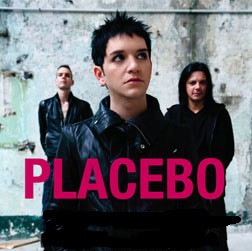


Feb 9 2010

Placebo: Without You I’m Nothing

Grant J.

Placebo (1996) – 3 stars

Without You I’m Nothing (1998) – 4.5 stars

Black Market Music (2000) – 4 stars

Sleeping With Ghosts (2003) – 3.5 stars

Meds (2006) – 5 stars

Battle for the Sun (2009) – 3.5 stars

placebo

Placebo, I suppose you could say, is a cult band, one of those prototypical you-get-them-or-you-don’t bands.   At least, that’s what most of the U.S. music critics, who consistently endow polite but somewhat tepid reviews on them, would have you believe.  A band that has achieved far more recognition in Britain than America, they turn some people off with Brian Molko’s unique voice and the hints of androgyny dropped everywhere in their songs.  

Yet even if you don’t buy all that Molko is selling, you should still be able to enjoy their dark and ominous yet melodic and fiercely stylish tunes.   Then again, if you do take to his nasal voice and his laments about the corrosive influence of temptations like drugs and sex, then you’re in for a whole different ballgame. 

The debut album is their least distinctive and most straightforward, but it does a decent job of introducing their brand of rock, indebted to 90s alternative but darker, sonically and lyrically.  The heavy crunch of the drums on “Come Home” provides an apt backdrop for Molko’s cries that he’s throwing himself “from skin to skin, and still it doesn’t dull the pain.”  Later, on “36 Degrees,” the album’s best track, he proclaims “I’ve always been an introvert, happily bleeding.” 

Hit single “Nancy Boy” was perhaps the first indication that these boys had more than girls on their mind (Molko is a bisexual and bassist Stefan Olsdal gay, I suppose validating Molko’s claim that the three-person band is half-straight, half-gay), but the album’s second half is considerably weaker than the taut first four songs.
 
Without You I’m Nothing  continues the trend of having a popular song that’s actually relatively underwhelming (“Pure Morning”), but that’s no matter, because it’s a great leap forward, the album that put Placebo into the big leagues.  The band sounds invigorated and lively, and the diversity of sounds and ideal track ordering makes the album feel much greater than the sum of its parts. 

Lyrically, Molko mostly discusses flawed relationships, and like the band, he has improved.  “Ask for Answers” mentions relationship bonds “wrapped in lust and lunacy,” and on “Every You Every Me” (which opened the film Cruel Intentions) he cries, “Carve your name into my arm / Instead of stressed I lie here charmed”—all in all, his metaphors indicate that need to have something that hurts him.  The depressiveness of his lyrics might surprise you on such exhilarating tracks as “Brick Shithouse” and “Every You,” but he also imparts a sense of urgency, a burning need for love that always feels out of reach, that’s appropriate for the music, especially on the stunning title track.

Black Market Music continues in a similar vein, albeit with a few new sounds, which produce intermittent success.  “Spite & Malice” dabbles in hip-hop but otherwise goes nowhere, and the album doesn’t flow nearly as well as its predecessor, but their dark sound hasn’t stopped being compelling, from the techno-sampling “Taste in Men” to “Haemoglobin,” where Molko’s voice sounds as processed as Bono’s on “The Fly.” 

The paean to drugs this time is “Special K,” which is heavy enough to be a killer live, yet backed with an undercurrent of melancholy, all put forward with a heavy dose of melody and feeling.   Molko’s lyrics aren’t as sharp overall as before, but he scores with closer “Peeping Tom,” writing as someone who’s relegated to only being able to peer into his former love’s life from a distance.

Sleeping With Ghosts is the least Placebo-ish effort in their catalogue in many ways.  Here, they slow things down considerably, beginning their two-album foray into electronic sounds.  Molko also tones himself down, conveying less interest in indulging all his fantasies and acquiescing to all his temptations.   Instead, he criticizes intolerance (title track) and plastic surgery (“Plasticine”), and who could have previously foreseen Placebo writing a song called “Protect Me From What I Want”? 

The increased lyrical breadth at least tells us that Molko doesn’t have a one-track mind, but a Placebo fan might have a hard time soaking up this album like others.  Yet, all told, it flows very well, alternating frequently between “Every You Every Me”-style spikes and atmospheric laments with those studio sounds.  Dazzling rockers “This Picture” and “The Bitter End” explode out of the gate, the instrumental “Bulletproof Cupid” ratchets up the heaviness factor, and “Second Sight” abounds with color. 

Melding their perfectly-incorporated electronic sounds to their richest and densest songs yet, Meds represents the group’s career apex.  “Meds” and “Infra-Red” seethe with dark intensity, and the latter and “Pierrot the Crown” indicate that Molko still has a morbid fascination with the menacing.  

But other tracks find them using new angles and approaches: “Space Monkey” and “Follow the Cops Back Home” amplify the atmosphere to the point where you feel like you’re floating in the middle of the ocean.  And then there’s a segment in the midsection (the four songs from “Post-Blue” to “Lazarus”) where Molko is yearning rather than tragic.  Indeed, “Lazarus” criticizes someone who doesn’t believe that “all is not lost.”  Though Molko cries “You don’t believe me / But you do this every time” on the stellar “Blind,” he’s not accusatory, as one might expect, but rather desperate for the connection that’s out of reach.   

That newfound hopefulness continues on 2009 release Battle for the Sun, where the groovy title track announces that the tentative denial of temptation first seen on Sleeping With Ghosts has now become a full-fledged turn away from the destructive. (“You are a black and heavy weight / And I will not participate”) On “Bright Lights” and “Kings of Medicine,” Molko also seems to be renouncing the use of drugs to palliate one’s emotions.  Is this still Placebo? 

Yes, never fear, it is, as the snazzy “For What It’s Worth” or the epic “Happy You’re Gone” demonstrate.  Battle, though, is one of their more calculated works, and the songs are too self-consciously constructed as perfect pop tunes, with melodramatic bursts and an occasional sense of the band trying too hard.  The strings, keyboards, and horns help flesh out the sound (used best on the title track and “Kings”), but they also exacerbate the radio-accessible feel.

Thus, in the end, Battle sounds better in small doses, when you’re not hearing slightly overwrought sentiments 13 times over.  Nevertheless, the band continues to impress with their ability to construct adrenaline-pumping, vibrant, and, still, sexy tunes.  There’s no doubt that they haven’t lost that burning desire—just maybe that desire for what you shouldn’t have.    

http://www.myspace.com/placebo


Sep 12 2009

Muse – Absolution (2003): I still feel dirty

Grant J.

absolution 

Rating: 2 1/2 stars (out of five)

You can’t read eight words on Allmusic’s biography of Muse without reaching the word Radiohead; and given lead singer Matthew Bellamy’s obvious love for Thom Yorke, that’s not a surprise.  Musically, though, Absolution, the band’s third album, doesn’t really resemble any Radiohead discs.  There are hints of The Bends here, but with its dark stylings and heavy dose of drama, Absolution reminded me more of Placebo.  The problem, though, is that Muse, a relatively unknown band quickly gaining in prominence, sounds like Radiohead- and Placebo-lite, without the skill to transcend their influences. 

Absolution is filled with Bellamy’s paranoid and stark observations about the future of the world lined up next to the band’s oppressive sound.  The two forces fit each other, there’s no doubt about that, but the combination just doesn’t work.  This is largely because the music, and the production, sounds horribly claustrophobic.  The songs are not allowed to breathe whatsoever, and by mid-way through the album, the listener craves a break.  More talented bands and producers have created albums that are depressive and/or haunting, to be sure, but here Muse miss that target and end up sounding swampy and muddled.  The production further becomes a problem because there is very little melody anywhere to be found here; these two facts leave Muse playing intense but indistinctive and sludgy rock.

Fans of alternative rock may find enough to like here, especially on “Time is Running Out” and “Falling Away With You,” but repeated listens reveal too many imperfections in the songs and the lyrics.  Tracks like “Stockholm Syndrome” arrest attention on first listens, but after a while they don’t seem to hold together, simply fading away into irrelevance in the listener’s mind.  “Blackout” sounds appealing at first, but by the end of the song, Bellamy’s words starts to grate.  He moans uber-pessimistic lines like “This love’s too good to last” without ever really telling us why.  “I’m too old to change”—really?

Elsewhere, he rants that “This is the end of the world!” and “The end is all I can see,” which represent the tone of the entire album, but none of it registers much of an emotional impact.  As “Blackout” makes clear, Bellamy doesn’t take the next step of telling us why he’s so paranoid, what makes him so pessimistic, what perspective he can offer us besides apocalyptic visions.  He also slips up lyrically on “Falling Away,” where a multitude of absolutist clichés (“I’ll love whatever you become”; “I know I won’t forget a thing”; “All of the hopes we cherished fade”) de-mystify an otherwise stately song.

“Time is Running Out” deserves keeping around, possessing both a melody and a skillful build of tension.  The mischievous lyrics—easily the album’s best—express that undeniable but often unexplainable interest in unstable relationships (“You’re something beautiful, a contradiction / I wanna play the game, I want the friction”). They’re less successful at relating to the album’s overall theme (as expressed in the song’s chorus and title) that we’re all doomed, as Bellamy likely wanted them to, but they work in the four engrossing minutes of the song.

But ultimately, Absolution, despite being just 12 earnest songs (two brief Morning Glory-style instrumentals not included), feels overwhelmingly long, a fact traceable to the oppressive sound and unmemorable songs.  Rolling Stone’s Album Guide describes an album by Scott Walker as “top-heavy with pretentious abstraction, self-consciously difficult and often actively unpleasant,” which sums up my feelings on Absolution pretty much to a T.  In small doses, Muse’s music works better, but they have a long way to go before an entire album is worth listening to.