
Jul 14 2010

Children of Men: Beauty amidst chaos

Grant J.

Rating: 4 stars (out of 4)

“With Inception hitting theaters, we take a look at movies that take a dark view of the future.”  So declared the Rotten Tomatoes website today, and in the same spirit, I revisit 2006′s criminally underappreciated sci-fi classic.

Every once in a while, a movie comes out that puts together every aspect of cinema so magnificently that you can’t imagine how it could be better.  Such movies don’t remind you why you go to the theater; any solid one can do that.  Such movies instead remind you of the transcendental power of cinema, the life-affirming revelation that all great literature, music, and movies can possess when constructed by masters.  Children of Men is such a movie.  Upon its release, this was the best film to come out since 2004.

Based on the science fiction book by P.D. James, Men is set in Britain in 2027, when the world is exactly like ours but for one crucial difference: humans are infertile.  No one under 18 years old is alive.  The government passes out suicide kits with the slogan, “You decide when.”  With no prospects for long-term survival, anarchy is the rule around the world.  Britain arrives at the most successful method for handling the situation by prohibiting immigration, deporting and locking up any illegals, and enforcing a police state.  A walk to work is an opportunity to be attacked by a rabid police dog.  A visit to a coffee shop in the morning might be your last.  Is it the lack of innocent children that corrupts people?  Or the sheer fact that there’s nothing to live for?   

Clive Owen prefers to play amoral characters, and he has a particular affinity for people who derive strength from destruction occurring around them (see Croupier, Closer).  Yet here it is the rest of the world that has fallen apart while he ultimately finds a measure of decency and redemption.  He plays Theo Faron, an ex-activist now resorting to mindlessness.  He carries too much suffering from his past to be bothered by the death of the youngest person alive, which captivates everyone else.  His ex-wife Julian (Julianne Moore) takes him out of his shell by arranging for him to be the caretaker of Kee (Claire-Hope Ashitey, solid), an African woman who miraculously is pregnant.  The government wants no part of any foreigners, and rebel groups want to use the baby for political purposes, so it is left to Theo to keep her safe and deliver her to the Human Project, an organization dedicated to planning for the future.   

The set-up might seem a perfect opportunity to lionize Theo, but the movie never makes that mistake.  He’s a broken-down man who fights for Kee because she reminds him of the child he and Julian had together who died at the age of two.  Children of Men, though, is less a character analysis than a study of the human condition.  Theo speaks to both the ways that society and culture can shape an individual’s behavior and to the extent to which one can forge his own path.  Theo, having endured too much pain at the hands of fate, has withdrawn from life at the beginning, but the arrival of a baby transforms him, most notably in a stunning scene in which he delivers the child.  But there are also smaller decisions he makes independent of fate, which together are the main reason you walk out of the theater feeling good about humanity amidst the terror and carnage.

In many respects, Children of Men is an adventure story, as Theo and Kee, with a midwife named Miriam (Pam Ferris), have to escape and evade the violence surrounding them, but it is filled with so many rich scenes and tender moments of humanity that it transcends its genre.  Though a violent rebel group named the Fishes wrecks their plans more than once, there is no battle against a specific enemy here.  This is a battle against the world, against our human flaws, against apathy, against dangers that we bring upon ourselves. 

Director Alfonso Cuaron allows us to see small measures of goodness amidst the carnage: how people try to replace children the best they can with pets—dogs, kittens, sheep, roosters, goats, and birds roam the squalid streets and buildings—as though they must care for something.  After Kee’s baby is born, it is Theo, not the mother, who knows how to care for the baby; he’s done it before, but no one Kee’s age has even seen a child.  And Jasper (Michael Caine, also impressive), Theo’s best friend who deals with the end of the world with strawberry-flavored weed and classic British music, provides some levity but also deeply cares for his catatonic wife, a former journalist who was tortured, probably for exposing the nasty ways of the government.  In both the sunshine in his scenes that belies the generally grey and dark blue hues of London and in Theo’s rare laughter around him, viewers can observe how much joy Jasper brings.     

None of this, however, can obscure the movie’s darkness.  It makes a statement about what would happen with no children to keep us innocent and no accountability for adults’ actions to keep our base desires in check.  It’s not political, but the implications of the anti-immigrant policy reverberate, particularly in a startlingly close to home depiction of a refugee camp that would not be out of place in today’s news.  In another poignant scene, Miriam explains to Theo what the gradual awareness of infertility felt like, in an abandoned school where the playground is desolate except for the quiet humming and singing of Kee, reflecting her divorce from the rest of society.  “I was there for the end,” Miriam says, and Theo, watching Kee swing, replies, “And now you can be there for the beginning.”  He wants her to relish that, but this movie informs us that this wouldn’t necessarily be enjoyable if we continued to acted like this.

All the touches from the hand of Cuaron, who collaborated with four others on the screenplay as well, have a revelatory effect: the chilling music that underlies a cold shot of a London alleyway before Theo and Kee traverse it; a camera shot that lingers for a moment on a kitten crawling up Theo’s leg; the high-pitched ringing noise in Theo’s ears, reflecting his proximity to a prior bombing, that ominously plays periodically throughout the movie.  Even when you don’t think Cuaron’s doing anything, he is, be it through purposeful background music, a camera splattered with blood, or a vivid, single-shot presentation of a car attacked from all sides using a hand-held camera.  He understands the power of creating a world in which you can lose yourself for a couple hours.  So many movies fail to take advantage of scenery and background, existing in nondescript places, but cinematographer Emmanuel Lubezki and Cuaron create a London 20 years from now—complete with houses literally barricaded from the outside world, billboards declaring that avoiding fertility tests is a crime, and bone-shattering explosions in coffee shops—that stays with you long after the credits roll.

And the last ten minutes are by themselves more emotionally affecting than most movies taken as a whole, one of the top five most affecting segments I’ve ever seen on film.  From the moment when the cries of Kee’s baby silence a squadron of government troops pounding a rebel hangout to the concluding scene in a boat, Children of Men goes from being a great movie to an exceptional one.  Hope mixes with despair, as the desires of the soldiers to get a look at the baby are diverted by a bomb from the rebels and as Theo shows Kee how to hold the baby amidst fighter planes lighting up the morose sky.  In his face as he carries the two girls away from danger, it is also, once again, apparent that Clive Owen plumbs emotional depths that few other actors can.  He resists the natural urge to look sanctimonious, or foolishly proud, or smug; instead, he cares about nothing more than protecting them, and his eyes simply gaze outward, as though looking towards the future.  He looks real—battered and bruised but finally stable.  For the first time in many years, he’s happy that he opened his eyes in the morning—just like us.


Mar 7 2010

Shutter Island: Live as a monster or die as a good man?

Grant J.

shutter island

Rating: 4 stars (out of 4)

In a revealing late chapter of Harry Potter and the Deathly Hallows, Harry asks Professor Dumbledore whether their poignant interaction has been taking place for real or merely in his head.  “Of course it is happening inside your head,” Dumbledore responds, “but why on Earth should that mean that it is not real?”

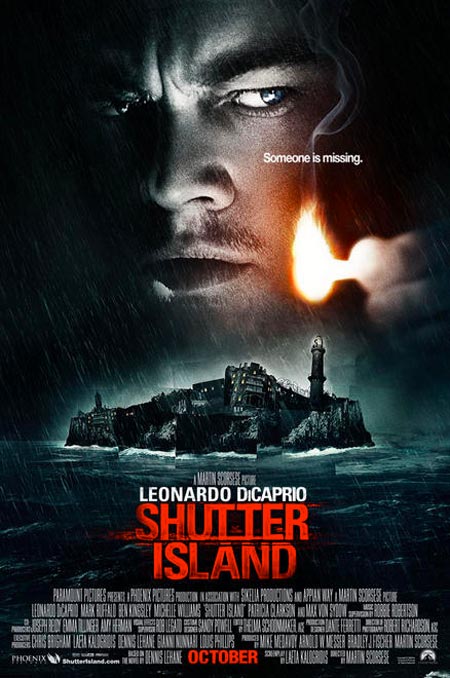
Leonardo DiCaprio’s character in Shutter Island personifies that sentiment—all its heartening and worrisome consequences—perfectly.  We might not agree with it at first, but the more you think about this movie, the more it makes sense, after your brain is melded, stunned, reversed, reversed again, and invigorated.  Filled with disturbingly bone-chilling moments the likes of which few movies possess, Shutter will mess with your mind, and then it will leave you in feverish contemplation of its ideas.  There’s one jolt after which the audience jumped more noticeably than I’ve ever seen before in my life.  It made a (female) friend cry extensively, made a (male) friend turn to me repeatedly to tell me how creeped out he was, and left me, like all my companions, legitimately clueless of what was going to happen in the climax—a staggering, and incredibly rare, combination of forces.

And then, afterwards, it’s provoked hours of discussing amongst everyone I’ve seen it with.  Given potential by Dennis Lehane’s book (the man behind only Mystic River and Gone Baby Gone), director Martin Scorsese, his cinematographer, composers, and actors transform it into something enduring.  If movies are designed to arrest the senses, to provoke extreme emotions, to force examination of thoughts and feelings that might not otherwise be considered, then it’s clear why Shutter Island will be repeat viewing for anyone who sees it.

Set in 1954, with Communist paranoia as just one component of dread, Shutter teams Scorsese up for the fourth time with DiCaprio, who plays U.S. Marshal Teddy Daniels.  He and his partner Chuck Aule (Mark Ruffalo) have been assigned to visit Shutter Island, an ominous piece of rock off the coast of Boston Harbor that houses a mental institution for the criminally insane.  Teddy and Chuck were sent to investigate the unexplainable disappearance of one of the inmates, Rachel Solando, who, we are told, lives in denial over her murder of her three children.  Teddy and Chuck are assisted, to an extent, by the facility’s head doctors Cawley (Ben Kingsley) and Naehring (Max von Sydow), and the actors’ (particularly Kingsley) strike the perfect balance between creepiness and kindliness that only muddles our perceptions even more.

Before long, we discover that Teddy stalks the island for reasons beyond Rachel’s disappearance, but we’re not sure exactly what they are.  Is it because he’s trying to uncover evidence that the seemingly good-natured psychiatrists are actually performing mind-altering experiments on their human patients?  Is it because his past—deaths within his family, wartime trauma—compelled him there, perhaps in search of another patient?  Will he ever make it off the island, and if not, will it be because the doctors refused or because he legitimately didn’t belong anywhere else?  Just how much can we believe him?  Or are both parties not to be trusted?

Scorsese embellishes these feverish questions with a dazzling array of sights, sounds, and visual tricks so absorbing that you’ll probably be having dreams about them afterwards—and not pleasant ones.  Teddy’s own disturbing nightmares about his dead wife and his past begin to overlap, more and more, with the missing woman and what we perceive to be “reality,” to the point where we stop being able to clearly identify what exactly is happening.

And when you leave Shutter Island, you’ll wrestle with your inability to state exactly what “happened”—both because that question can’t really be answered without reference to specific characters’ perspectives and because Laeta Kalogridis’s script doesn’t have any interest in giving you a simple resolution.  Is there actually a ‘twist’ in play, or not?  Reviewers seemed perfectly content to accept the plausibility of the apparent twist, but after countless hours of reflection and discussion with others, I have too many doubts.

Moments like Ruffalo’s final spoken word, Cawley’s dubious claim that they’d broken through to Teddy 9 months previously, and the overstatement of the heinous nature of Teddy’s crime by Cawley pushed me towards thinking that he’d really only been there for 2 days.  The parallel seemingly drawn with the older woman who killed her husband in somewhat-believable circumstances seemed a crucial indictment of the institution as well, as did a few things Cawley said that didn’t seem compatible with the presumed twist.  But almost everything here can be taken as evidence for either perspective.  Ruffalo’s word could have been part of Teddy’s delusions.  And—critically—there’s acting involved either way; either the institution was involved in a dramatic ‘role play,’ or everyone was trying to push Teddy further into paranoia in order to paint him with that brush.

In fact, that confusion is PRECISELY the point of Shutter Island: how fine the line is between the sane and insane.  If you were insane, would you know it?  Did Teddy know it?  Who can say?  And, the movie proposes, couldn’t anyone could be insane and not know it.  If you were painted as insane, would you accept it?  Or would you think you’d been mis-characterized?  And doesn’t Teddy truly personify the concept that (in)sanity isn’t an all-or-nothing proposition?

Philosopher Renee Descartes formulated the famous “Dream Argument,” the notion that, since during dreams we are unaware of their fakeness, what we consider our normal lives could, analogously, all be a dream, could all be manipulation and deceit.  Of all the creepiness and shocks in Shutter Island, that’s the most discomforting thought—that anyone could either a) painted as insane or b) actually be insane.  That’s why the mind-melding of the movie’s tricks works so well on us, just like in A Beautiful Mind; we’re feeling what he is.  Who’s insane, and who’s to determine that?  Was Teddy unable to completely hate his wife because he saw that he could have easily been turning into her?

Shutter raises all these questions pointedly, creepily, coldly efficiently: how resilient and smart was Teddy, and how capable was he of being manipulated?  The film makes numerous references to his intelligence, as if to ask: under certain circumstances, is it ‘smart’ to be insane?  The comments from various patients who expressed no desire to leave the institution out of fear that the outside world had passed them by sounded remarkably forward-thinking.  So was Teddy’s ‘decision’ to create an alternate persona for himself evidence of insanity?  Or did it enable him to lead a more stable, productive life?  And was it smart that, whether or not he was acting with his final comments, he wanted everything to end?

But even if Teddy had accepted his fate, isn’t it the case that the institution had won, that he was doomed regardless?  And if you thought anyone could be insane—including yourself—wouldn’t you oppose the thought of authorities declaring who was?  The island is so close to Boston, but it may as well be a million miles from anything.

Wow.  How often does a film make the most of everything from its opening shots—the shrewd symbolism of showing DiCaprio’s face through a mirror and then straight on, highlighting his dual personalities—to that infinitely fascinating final exchange, wrapping up everything and nothing all at once?  In an age when movies are made with such extreme caution, with such an obvious desire to appeal to the least common denominator, Shutter Island explodes as a maverick, structurally, thematically, visually, emotionally.  After each viewing, I haven’t wanted to do anything (other than talk about it), sometimes just driving or walking around aimlessly, lost in contemplation and well aware that I wouldn’t be able to focus on anything else.  After my first two viewings—on the same day—I was convinced it was an outstanding movie, and my feelings have only intensified since then.

Amidst all the discussion it provokes about sanity, instability, knowledge, and uncertainty, the most important take-away message might be that the true dangers in the world come not from external sources to which we apportion blame, but from within, from our own terrors and uncontrollable urges.  Teddy, we can gather from skillfully placed background information, couldn’t deal with his wife’s demons because he was too occupied with his own, and he couldn’t deal with his own because he wanted to fear and blame something outside of him.

Just like The Bourne Ultimatum, Shutter Island has become the latest feverishly-anticipated movie that nevertheless blew me away.  It will without question define my senior year of college and 2010 in general, and for many years in the future it will become one of the first “Have you seen…?” questions I ask people when the conversation turns to movies.  Despite the fact that it’s more of a short-story than a novel, really, and that it unashamedly flaunts its creepiness, it has virtually nothing that’s not exceptional.  There’s DiCaprio, masterfully portraying Teddy’s ‘descent’ into insanity, a performance that just gets better the more you know about his character.  There’s the seemingly endless debate and discussion it provokes, both about its involuted storyline and the philosophical issues it raises that relate to us all.  And there’s that visceral intensity, that psychological gut-punch, that ferocious look on DiCaprio’s face that keeps telling us there’s even more to see, more danger around the corner, more mysteries of the human mind yet to be uncovered, more depths of cruelty yet to plunge.


Jan 30 2010

Blind Side: What are the real parts again?

Grant J.

blind side

Rating: 1 star (out of 4)

Hollywood studios like to propagate the idea that romantic comedies are suitable for both men and women.  Blind Side isn’t a rom-com, but doubtless this idea still came to them—hey, let’s combine Sandra Bullock (the women) and football (the men) to draw in maximum viewers.  Add the holiday season and a feel-good true story and you’ve got yourself a sure box office winner.

And, indeed, Blind Side has, along with The Proposal (and, I suppose, All About Eve) helped make 2009 the best box-office year of Bullock’s career, which must make the ineptitude of these films forgivable to those in the suits.  In this true story adaptation, Bullock plays Leigh Anne Tuohy, a Memphis socialite living the good life, thanks largely to the fact that her husband Sean (Tim McGraw) owns 85 Taco Bells.  She takes an interest in a student who was recently admitted to their kids’ private Christian academy, the imposing football player Michael Oher (newcomer Quinton Aaron). 

Michael’s life reads like a fairly typical sob story—crack-addled mother, no father, never been educated properly—but despite that and his overwhelming size, he’s calm and polite.  Leigh Anne takes him under her wing (and roof) and helps him hone his football skills, helping him ultimately go on to receive a college scholarship and a first-round draft pick of the Baltimore Ravens.  An interesting story, but, sadly, in telling it, director and writer John Lee Hancock utilizes all of the clichés and wooden characters that surrounded his last sports flick, The Rookie.

Is anything real or believable in this movie?  Certainly not Michael’s first night in Leigh Anne’s house, where she plops him on the couch because the guest room has boxes in it; please, woman, that house has five guest rooms.  And not the football scenes, which hit perhaps a new low for Hollywood.  The film apparently wants us to believe that one excruciating scene of Leigh Anne playing coach for a few minutes qualifies as Michael being taught how to play; of course, there’s a lot more to playing lineman than size, but oh well.  I guess that’s not important in a movie that wants you to believe that one good block means the running back can saunter in from 70 yards away for a touchdown, or that referees really wouldn’t be able to come up with a penalty for shoving someone over the field boundary (it’s called unnecessary roughness, guys).  

And it doesn’t help that Michael’s coach (Ray McKinnon), uh, isn’t exactly Billy Bob Thornton or Denzel Washington.  He’s not a good enough actor to make us understand that, when he sincerely pitches Michael’s school admission to the deans, he’s furtively concerned about his own team’s success.  (We assume that to be the case, independent of his acting, but when including the acting we’re just confused.)  He has plenty of company, though, as good acting is hard to be found here.  As laconic Michael, Aaron is fine, but McGraw and Bullock can’t find any kind of true emotions.  McGraw looks like someone behind the camera is giving him instructions at all times (where is the talent from Friday Night Lights?), and I can’t for the life of me figure out why so many critics are calling Bullock’s performance her career best.  I often like her, but this may be the worst I’ve ever seen.  In her attempt to break away from her breezy roles and look “solemn” or “serious,” she transforms herself into an utter statue, completely lacking in human emotion or realism.  She looks awkward in just about every scene, as though she’s reading the words for the first time.

McGraw and Bullock certainly aren’t helped by a script that paints the family dynamic in unrealistic and annoying ways.  The writers think they can show spousal love with vague, bland irritations—the ‘I can’t stand how she does this, but that’s why I love her’ nuisances common to such films—and they introduce yet another annoying little kid.  Jae Head’s young SJ almost manages to attain the mind-blowingly irritating level of Hayden Panettiere in Remember the Titans.  (Largely because of this, it was to my immense relief that Leigh Anne’s daughter wasn’t a typically “angsty” Hollywood teenager.)

And the script also makes a mockery out of painful stereotypes—both black (everyone in the ‘projects’ where Michael’s mom lives) and white (heartless rich bitches that Leigh Anne lunches with).  That’s in between its presentation of such bon mots as “You’re changing his life”—“No, he’s changing mine” and Michael’s groan-inducing, predictable-but-unbelievable “Don’t lie to me” retort to Leigh Anne.  In your face, woman!

Amidst all this, the plot is a mess, going fully sideways after what feels like the climax into an utterly unnecessary final scene with Michael at the projects, topped in absurdity only by Leigh Anne going back there—disregarding Michael’s earlier words of caution by wearing a ridiculously provocative dress—and getting in the face of one of the thugs in a move that makes you want to throw something at the screen.  Such moments are particularly troubling because they seem to be replacing what might have been meaningful scenes: by the end, one wonders why no more mention was ever made of Michael’s briefly seen brother or his mother—did he never say anything about them as he was preparing to attend college?

It’s remarkable that this movie needs more scenes, given that there are so many gratuitous ones that bloat the running time.  Most movies of this ilk last—as they should—about 90 minutes, yet, for reasons passing understanding, Blind Side runs two-and-a-quarter hours—but then again, most everything about this movie was done for reasons passing understanding.


Sep 14 2009

Cruel Intentions: Actually, they’re too nice

Grant J.

To commemorate the return of “Gossip Girl” tonight, let’s revisit a well-known but flawed 1999 movie that should be required watching for anyone who likes Josh Schwartz’s show…

 Cruel Intentions

Rating: two stars (out of four)

Watching Cruel Intentionstoday, in 2009, it was almost impossible not to think of “Gossip Girl,” the popular TV show that relishes the lascivious, mischievous, and devious exploits of uber-rich, uber-preppy high school students living on the Upper East Side of New York City.  The teenagers in this movie, backed with the both comforting and numbing knowledge that their careers and financial situations lack any semblance of uncertainty, introduce excitement into their lives with beguiling games to lure members of the opposite sex, snarling plots to humiliate enemies, and discreetly mentioned but explicitly realized sexual exploration.  Sound familiar?

Indeed, now I won’t be able to watch this movie again without seeing Chuck as Sebastian and Blair as Kathryn.  And my moderate knowledge of contemporary teenage dramas makes it easy for me to buy the capacity of these individuals to engage in such elaborate schemes, most of which are underpinned by the goal of enhancing their popularity.  Cruel Intentionsis based off Choderlos de Laclos’ novel Les Liaisons Dangereuses (which has been translated into film an astonishing four times), and some reviewers couldn’t buy the shift of the characters’ situations.  James Berardinelli wrote that, “What works with mature individuals in 1782 France seems false when applied to high school kids in 1999 America.”

Perhaps because of “Gossip Girl” and “The O.C.,” not to mention films like Thirteenpresenting young people growing old quite fast, and a sprinkling of my own experience thrown in, I wholeheartedly disagree with the above statement—it now seems more natural than ever for this kind of plot to be attributed to teenagers rather than old-fashioned Frenchmen.  That said…there wasn’t much more about the film that I could throw myself into.  This particular nefarious plot allows Sebastian (Ryan Phillipe), his school’s reigning Don Juan, and his stepsister Kathryn (Sarah Michelle Gellar, from TV’s “Buffy the Vampire Slayer” and most teenage boys’ fantasies) to work for and against each other at the same time (these things get complicated).

Kathryn, irritated that her ex-boyfriend preferred the nubile and naïve young Cecile (Selma Blair), solicits Sebastian to work his magic on her and help ruin her reputation.  He complies, but he’s more interested in a greater challenge—deflowering (the back cover of the DVD actually uses that word) Annette (Reese Witherspoon).  Annette, who conveniently happens to be the daughter of the school’s new headmaster and is thus moving to town, wrote an article for a teen magazine extolling the virtues of virginity before marriage; this, combined with her looks, makes her irresistible to Sebastian.

Kathryn wants his car if he can’t seduce her; if he can, he gets Kathryn herself.  So there’s a bit of Clueless (with half-sibling relationships seemingly avoiding the stigma of incest) sprinkled over the “Gossip Girl” undertones. (The GG episode wherein Blair asks Chuck to seduce Vanessa with the promise of herself later bears a particularly uncanny resemblance.) Unfortunately, Cruel Intentions has little of the charm and zest of Clueless or the damn-the-stiffs embrace of decadence of “Gossip Girl.”  It’s too somber, too watered-down and safe, and, ultimately, too bland.

This is the kind of movie that should be described as a “doozy,” that should be full of delicious lines and lively acting and come-on-that’s-impossible-but-really-fun-to-watch plot twists.  But unlike “Gossip Girl,” Cruel Intentions doesn’t really seem to cherish its characters, faults and all—it makes noise about embracing them, but it’s really just disguising a morality play, and that’s no good here.  The heart of the matter is revealed by director Roger Kumble in the DVD’s special features, where he explains that he wanted to show nudity around Sebastian to illustrate his nature but cut the scene for fear of us not buying Sebastian’s eventual transformation into a PG-acceptable sweetheart—a direction that, I think, misses the heart of the story.

Elsewhere, we don’t see enough evidence of Sebastian and Annette melting away each other’s icy exteriors, and thus the central romance, vital to the film’s success, doesn’t resonate.  When Sebastian is fretting over his possible missed opportunity, or Annette is flashing back towards previous cutesy scenes, we aren’t emotionally engaged.  That’s not necessarily a knock on the actors, but rather on the script, which tries to fit too much into a 95-minute movie (would another few scenes have killed us?) and doesn’t allow for much character development.  There’s nothing embarrassing, but no dialogue, characters, or scenes really convince us that they’re worthy of our attention.

Brotherly love in New York City.

Brotherly love in New York City.

Phillippe is alright as Sebastian, although I got the feeling that, as the charming playboy, he was too dour—like the film, he doesn’t seem exhilarated by his character’s nature (compare with the wonderfully slimy Ed Westwick as “Gossip Girl’s” Chuck, who oozes an irrational fascination with both himself and his lifestyle).  Gellar too is relatively acceptable as Kathryn (though, again, she lacks Leighton Meester’s zest for bitchiness), as is Witherspoon (who looks more attractive than in anything else I can recall).  But too much credibility is lost with the insipid script, not to mention the ending, wherein both the moral lesson and the death are unnecessary.

One of the film’s best scenes features Kathryn lying on top of Sebastian and shamelessly teasing him, with no intentions of following through, to encourage him to keep his end of the bargain up (in more ways than one)—just the kind of devilishly entertaining moments we needed more of.  There’s another moment where Kathryn teaches Cecile how to French kiss, and by the end, the latter looks like she desperately wants more…and so do we.


Sep 4 2009

Friday Night Lights: Football, not life

Grant J.

September has arrived, and the weather seems to be starting to cool down, which means that it’s finally time for some football.  High schools are the first to start playing (there’s still another agonizing week before the NFL season kicks off), so this Friday is a perfect time to highlight the best football movie that I’ve ever seen.  Let the games begin…

Rating: three 1/2 stars (out of four)

“When you’re famous at 18, you spend the rest of your life fading away.”

The lead character of John Grisham’s delightful novella Bleachers spoke those words, and they apply perfectly to the attitudes explored in Friday Night Lights, which concerns the same material as that book: high school football.  This time, the focus is on not only the team but also the suffocating culture that surrounds it.  Based on H.G. Bissinger’s book chronicling the 1988 season of the Permian Panthers of Odessa, Texas, Lights excels with traits that rarely come with football movies.  Indeed, it’s hardly a sports movie at all (just like how the Bournes are much more than spy flicks) but rather a realistic, emotive, beautifully-acted film that’s about the lives of its characters.  Although the yawningly overwrought description on the back cover doesn’t reflect it, the film cares about a lot more than the success of its team.

The movie is unflinching in its depiction of the town.  Director Peter Berg uses washed-out colors to make the landscape look even more barren, helping us to at least partially understand why everyone you meet is so obsessed with the only thing that gives their area fame.  The Panthers are the winningest high school team in Texas history, with four state championships to their name, but that matters little in the what-have-you-done-for-me-lately culture.  Football is the easiest way to make someone in Odessa happy, yet because of the way the town approaches it, it collectively sucks all the joy out of it.  Note the grim expression on the face of quarterback Mike Winchell (Lucas Black) when college recruiters tell him the game is supposed to be fun.  Media frenzies surround the first practice of summer, and when the father of a player (played by Tim McGraw) comes out onto the field to castigate him for fumbling, people stare, but no one stops him.  Eventually, a player steps in to say, “Please…it’s the first day of practice,” as if to say that such an outburst would be permissible when the team was supposed to be in mid-season form.

Most sports movies are by definition ensemble pieces, but there’s generally a hero to root for, namely the coach or quarterback.  Lights is even more egalitarian—no one could be considered the star.  The movie focuses mostly on third-year coach Gary Gaines (Billy Bob Thornton), Winchell, star running back Boobie Miles (Derek Luke), and fullback Don Billingsley (Garrett Hedlund), and it almost sneaks up on you in the way it fully develops its storylines with grace and intelligence.  Billinsgley, for example, has to deal with his abusive father, still living his life based on his high school glory days.  When Don keeps fumbling, his father takes out the anger that stems from his dead-end life on him.  But he isn’t the devil, just a misguided, alcoholic man who’s been burned out by life—who’s been fading away since 18—and assumes that the same will happen to his son after high school.  McGraw subsumes himself into the role and delivers a heart-wrenching performance.

FNL simply excels in its depiction of the characters’ struggles with holding onto any measure of joy amidst the despairing situation in which they live.  Black, an asset in All the Pretty Horses, effectively presents a hesitant quarterback who isn’t sure he wants to leave the town because of his mother’s ill health.  Boobie, excellently played by Luke, carries not only the expectations of the town but also the burden of being the team’s centerpiece.  He’s effectively lost for the season to injury in the first game, yet he and his uncle do all they can to avoid listening to doctors.  There’s an emotionally stunning scene when he sits in a car after clearing out his locker and realizes that he has never planned on a life that doesn’t include football.

Thornton’s coach regards the football obsession with a bit of bemusement, as he understands that a loss isn’t the end of a pursuit of happiness.  He is an atypical movie coach, neither a tough guy in the mold of Denzel Washington’s character in Remember the Titans nor a “players’ coach.”  Thornton, whose performance is the epitome of controlled yet evocative acting, says more with his eyes than words, but Gaines does give the Panthers the best speech I’ve ever heard in a sports movie.  At halftime of the state championship, knowing that the game represents the end of the football era of his players’ lives, he doesn’t try to make them believe they can do anything.  He just says, “Put each other in your hearts forever, because forever’s about to happen out here in a few minutes.”

How refreshing it is to reach the final scenes of a sports movie and be concerned with things other than a game’s outcome.  Panther wins don’t generate much emotion–they’re expected and accepted, but not experienced the way losses are.  Thus, if you understand by the end that Friday Night Lights has nobler goals than most sports movies, you won’t find the conclusion surprising.  And just as a critical mid-season loss leads to important conversations between Gaines and Winchell and Billingsley and his father, the climactic heartbreak allows the characters to show who they truly are.  As another magnificent piece of the soundtrack (which is mostly from masterful conceptualists Explosions in the Sky and Daniel Lanois) mourns with the players and fans, Billingsley’s father walks onto the football field and completes his character’s arc, making everything that came before meaningful.  And in the process, he gives us what is, without question, the strongest and most emotional moment I’ve ever seen in a sports movie–and one of the best in any, regardless of type.

Most sports movies try to lift you to the rafters based on the athletic talents of the players on screen; here is the rare one that does so based on the inherent quality of its filmmaking, based on the feelings generated by things like the last smile on Winchell’s face and the shocking postscript.  A win for the Panthers is a relief, not a triumph.  Friday Night Lights is the latter.