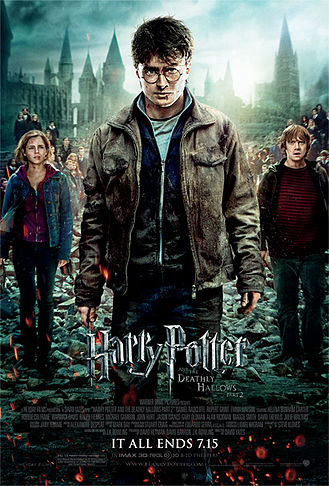
A Few of My Favorite Things 2011 #8: Harry Potter and the Deathly Hallows, Part 2

This is part of my 2011 wrap-up series, A Few of My Favorite Things, in which I discuss what I enjoyed the past year, regardless of when it was released.

#8 Harry Potter and the Deathly Hallows: Part 2

At the end of last year, I wrote about the first half of Harry Potter and the Deathly Hallows when I crowned it my 25th favorite thing of 2011:By design unsatisfying, the seventh Harry Potter movie is still in many ways the best of the series to date.

Part 2 gives us the payoff of Part 1’s intricate, hard-working set-up. It’s an inherently satisfying film as a stunning conclusion to a saga that’s been 14 years in the works.

A lot has been written about the eighth film. Pretty much everyone loved it. I won’t try and rehash the arguments in favor of the movie that critics have put more eloquently than I could.

Yes, Deathly Hallows Part 2 is wonderfully acted, crafted, and paced. It’s exciting and scary and sad and extremely faithful to the original. These can be said, to a certain extent, of all eight Harry Potter films, which never sunk below “very good” but failed to ever achieve “transcendent.”

But for a moment, I’d like to focus on a single element that has been an underrated key to why Deathly Hallows Part 2 was my favorite movie I saw in 2011 and probably my favorite of the series: The time frame within the story.

Aside from a few opening scenes, Deathly Hallows Part 2 takes place over a continuous timeline of about 24 hours. Compare that to each of the other Harry Potter movies, which all spanned almost exactly a year.

Think especially of Deathly Hallows Part 1. While beautiful and dark and enjoyable, it spans almost an entire year with no conclusion. It’s basically an extended bit of exposition to prepare for the non-stop action of the grand conclusion.

The plot of the Part 1 is, simply, a bit inert, moreso than any half of a Harry Potter story. A lot of the tension comes from the angst Harry and Ron and Hermione feel wandering and waiting for something to happen.

Part 2 is the exact opposite. In fact — ironically — the two halves of Deathly Hallows might be the two most different Harry Potter films in many ways. Part 2 is the brilliant, kinetic payoff that feels completely earned and fully realized because of the buildup we powered through a year earlier.

This capstone also gives us a chance to reflect on a series that has been one of Hollywood’s most successful ever, in terms of box office and in terms of cinematic quality. This is why I suspect it will earn a Best Picture nomination; the Harry Potter films have been continually appreciated (if not adored) by critics, and they end the series with its highest acclaim ever. The Oscars love lifetime achievement awards.

I know I clash with general fan consensus when I say the fifth film was probably my favorite of the series (excluding this film, which is tough to include in the field because it’s so fresh and only half of a story) and the sixth was maybe my least favorite. It’s hard for me to separate the films from their origin material, but Order of the Phoenix refines what made that book one of the best in the series and Half-Blood Prince muddles much of what made that book one of the best.

I’m always hesitant to put my opinions on Harry Potter films into virtual stone. My mind changes all of the time on which iterations of these series I prefer. I’ve only seen the Deathly Hallow movies once each, so my takes on each could change pretty drastically. I’m really looking forward to seeing each one again.

But there’s one thing that’s for sure: Deathly Hallows Part 2 marks the final Harry Potter book or movie that will ever be released (barring some sort of expansion by Rowling). It’s kind of the end of an era for me that’s spanned my most formative years and more than half of my life.

The Harry Potter series helped me discover how stories and characters can help you better understand the complexities of right and wrong. It cultivated a love of storytelling and fantasy and youth-oriented fiction that persists to this day. I owe much to the series and I thank it for an unforgettable decade-plus of fandom that will certainly stretch into a lifetime.

Previously: Bruce Springsteen – Hammersmith Odeon, London ’75

Up next: A terribly named but endlessly addictive history simulator

Harry Potter and the Half-Blood Prince (2009): It wasn’t half as good as it could’ve been

Rating: 2 stars (out of 4)

I didn’t like the sixth Harry Potter movie. I really expected to; I’m an apologist for the series, and David Yates’ effort before this was my favorite yet. Unfortunately, Half Blood Prince let me down. I’m here to tell you why it got way too much positive press from critics and viewers everywhere.

But before I start ripping into it, let me compliment the parts of the movie I loved:  its incredible – almost naturalistic – visual style, the best acting in the series yet, and a surprising amount of comedy. It’s easily the funniest Harry Potter yet. And the movie, at its core, is an interesting story that I’m very attached to. Overall, though, there’s just too little payoff to make this a rewarding film.

On to the complaints…

Like Harry Potter and the Order of the Phoenix, it took a second viewing for me to really decide how I felt about this Harry Potter movie. This time, though, the result was less favorable.

Most of my complaints stem from two major problems: The film doesn’t take the time to 1) understand evil or 2) give us much meaningful romantic payoff. I’ll discuss these two complaints separately.

Side note: Notice how I work hard to separate my feelings from the book and the movie; I’m attempting to avoid an error often made by those evaluating adaptations. I expect the film to be “different” from the book, I just hope it will turn into a compelling film.

Major complaint 1: The movie doesn’t care about its bad guys.

One reason I like the fifth movie so much is we really get a sense of what makes the two bad guys (Umbridge, Voldy) tick, and we can compare this to our heroes. Voldemort is attempting to take over Harry’s mind, Umbridge is villifying everything Harry loves, and it forces Harry to question what the line between good and bad really is.

But in the sixth movie, we’re not given much insight into the villains, even with a few revelations at the end. Why is Draco skulking around and plotting bad things? Why are the Death Eaters flying around blowing stuff up? What are their goals and their motivations? Nothing gave me a good grasp on the danger the characters were in.

There was ripe potential for the film to dig deep into the mind of Voldmort for the heroes (and viewers). The writers could easily have developed great insight into Voldemort’s descent and compared it to the decisions the current Hogwarts students had to make, but it’s not there. Chalk it up as a missed opportunity. The professors just keep saying “he was a kid here like you students, but he turned EVIL.” Fine, then. Show us how or why, make us care and compare it to the characters we know and love after 14 hrs of movies.

What bothers me is how much emphasis was placed on the love triangles. It’s not that the characters’ raging hormones and love triangles aren’t compelling. It’s just that they’re not nearly as compelling as the over-riding saga and rising villain which are given a short deal here. Love is a big part of these characters’ lives, but what makes this series special is its balance between the conflict in the characters’ relationships and the conflict in the overall saga, good vs. evil.

Major complaint 2: The romances are pathetic and overcooked.

The Harry-Ginny romance doesn’t seem to happen for much of a reason. Sure, Harry lists some of the things he likes about her at one point, but we’re never given a reason to feel their pull together. You never feel them really growing towards each other except for a few nice moments. Nothing substantial.

Compare that to how excellently Order of the Phoenix portrayed the rise and fall of the Harry-Cho romance, and it makes this one feel a bit empty. I’m hoping the seventh/eighth films dig into it a bit more and really makes me care about the two as a couple. Because, for now, I feel like the filmmakers are telling me to want them together without really giving me a reason.

The Ron and Hermione situation is treated more organically, but the execution is bungled. There’s just too much, with not enough payoff. The bickering drags on and on. You’d think with all of the setup this movie and the last, there’d be a big payoff scene or something, especially after the last two movie had so much build up to it. I guess this is a romantic cliffhanger and we’ll get a good moment later. I still wish there was a bit more resolution this movie.

Here’s hoping Harry Potter and the Deathly Hallows is rights these wrongs.