

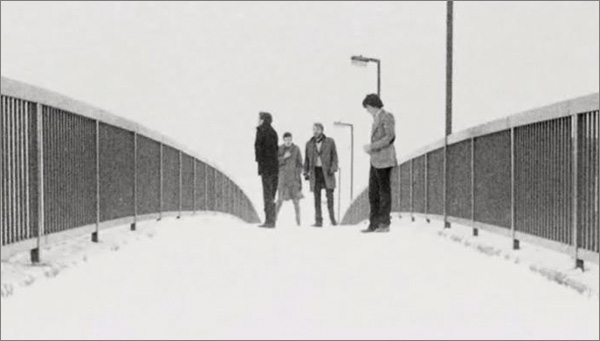
As far as I’m concerned, there’s no greater loss to music than the suicide of Ian Curtis at the age of 23. There’s no one I’d rather bring back for a couple decades of recording than him. That’s because the heights reached by him and his band, Joy Division, in their brief existence, are both nearly unmatched by anyone else and also infinitely frustrating for their potential. Joy Division occupies the second spot on my artist pantheon, trailing only U2, but Bono’s group has the advantage of more material; pound for pound, Joy Division’s sound is the most compelling I’ve ever heard. To try to imagine if they could have improved over time, as bands often do—my favorite U2 album is their seventh—almost makes my mind hurt.
Lead singer Curtis and his three band mates—Bernard Sumner on guitar, Peter Hook on bass, and Stephen Morris on drums—created the most exquisite, heartbreakingly beautiful music in rock history, all with just two albums and a few singles. The depths of emotion explored, and the intricacy of the music and production, place them on a level entirely their own. They grew out of punk (inspired especially by a Sex Pistols concert) but ended up sounding nothing like it—nothing like anything, really. Working with revolutionary producer Martin Hannett, they slowly and painstakingly brought forth, as Rolling Stone wrote, “as dramatic and severe a rethink of rock’s aesthetic parameters as has ever been envisioned.”
Song for song, debut album Unknown Pleasures evokes similar feelings as watching a peerless athlete or actor does; you simply feel that it’s on a different level than everyone else. The immensely talented Hannett amalgamated the individual musical components—Sumner’s icy sheets of guitar; Hook’s high-end, melodic bass; and Morris’s crisp drumming—into a sound so dark and disturbing that it teeters right on the edge of mental insanity.
Hannett added a variety of additional sounds, some musical (keyboards, synthesizers), some not (breaking glass, a creaky elevator rising) to the songs, which faded in slowly, reluctantly, with the pain of despair. And then they exploded, like someone trying, and failing, to not lose his mind. But what elevates the production is not merely the addition of unusual sounds, but rather the use of space. I’ve noticed that most reviews mention this–Allmusic says that Hannett ’emphasized space in the most revelatory way since the dawn of dub’–but typically in vague terms. That’s because it’s so hard to describe, yet so hard to forget. Despite the sharpness of the components–Hook’s bass carrying so much melody, the guitars dripping with reverb, those icy drums controlling it all–it feels like there are miles and miles of space in between everything. I’ve never heard anything like it.
The music is perfectly matched by Curtis, whose suicide just before the band’s first American tour makes his lyrics uncovering the scariest feelings of the human heart all the more penetrating and real. Ravaged by both epilepsy and an inability to keep minor flaws from consuming him, he inspires little doubt about whether he felt everything that he sang about. A line off their second album accurately describes his vision: “We knocked on the doors of Hell’s darker chambers / Pushed to the limit, we dragged ourselves in.” But Curtis explored such despair and resignation with an intelligence and humanity virtually unmatched in music. He wasn’t just blandly depressed; he was bewildered and intrigued by the vagaries of the human heart, disappointed in his own hypocrisy and failings, and despite it all, hopeful—hopeful for connections that he never found, for the ability to feel something that would get his heart racing. And he turned his own failings into world-class tragedies, which is probably why he couldn’t stand to carry on. “New Dawn Fades,” “Shadowplay,” “and I Remember Nothing” are some of the most heart-wrenching depictions of failed connections anyone’s ever sung.
On the astonishing, flawless “New Dawn Fades,” Hook’s bass comes in like the shadow of someone walking away in slow motion, before Hannett places Sumner thick and pervasive on top. It all unfolds with utterly perfect timing and tension/release, and Curtis chronicles the attempt to make sense of a relationship that one failed in maintaining: “It was me, seeing me this time / Hoping for something else.” Likewise, “Shadowplay” highlights Curtis’s morbid analogies about failed relationships; on this one, you can tell that Hannett loved the drums above all, and yet, it’s that bone-chilling guitar that stays in your mind. An exercise in precision.
But the exercises will force you to delve into the deepest recesses of your mind. “Insight” fades in slowly, with that elevator creaking and a bass line that sounds like a death march. Curtis sighs, “Guess your dreams always end / They don’t rise up, just descend…I’m not afraid, not at all / I watch them all as they fall / But I remember when we were young.” On this song, he’s under control, lamenting the loss of innocence, but on the breathtaking climaxes of “Disorder,” “Day of the Lords” and “New Dawn Fades,” he sounds as though he’s about to burst.
The album closes with its most disquieting note, the funereal “I Remember Nothing,” as Curtis’s words—“Violent, more violent, his hand cracks the chair / Moves on reaction, then slumps in despair”—fade away ominously into the remembrance of those unusual sounds.
Amazingly, Unknown Pleasures would have been even better with the inclusion of “Atmosphere,” one of several non-album singles Joy Division released that are captured on the 1988 compilation Substance. On the best, including “Transmission,” Hannett’s production acquires even more prominence. And by the time the band wrote “Love Will Tear Us Apart,” Curtis had begun to have an affair with a Belgian journalist following the band. “Love,” their only real pop song, became their biggest hit, which has to be somewhat irritating for JD fans. Musically, this is nothing special, and it doesn’t really sound like Joy Division; it’s not representative. But it’s certainly well put-together, and Curtis’s lyrics provide some of the most achingly real depictions of failed love ever set to music: “Did you cry out in your sleep, all my failings exposed? / There’s a taste in my mouth, as desperation takes hold / That something so good just can’t function no more / And love will tear us apart again.”
Curtis’s thoughts were beginning to presage the end, but there was still another album to come. Closer, the group’s second and final LP, is viewed as their masterstroke by most critics, but I have it a notch below Unknown. That album’s songs were uniformly compact and focused, each one the equivalent of standing in a dark attic wondering what’s around the corner. Closer goes in a few different directions, and a few of the early songs don’t have the same overwhelming melodrama of UP. It’s less oppressive and more angular, but that occasionally produces moment of (slight) disjointedness.
But as the album progresses, it feels as though we’re walking through the final stages of Curtis’s life, his problems slipping inexorably out of his control and his outlook fading inexorably bleaker. The songs are no less devastating than before, and the fatalistic lamentations make it almost impossible not to wonder whether Curtis knew the end was near. “This is the crisis I knew had to come / Destroying the balance I’d kept,” he warns on the quietly morbid “Passover.” And the brilliant gothic undertones of “Heart and Soul” are just a warm-up for the three-song requiem that closes the album.
The incomparable “Twenty Four Hours”—the band’s all-time high point—finds Curtis at the end of the line: “Just for one moment, I thought I’d found my way / Destiny unfolded, I watched it slip away.” Hook’s bass, so often the dominant element, sounds like it’s coming after you–no matter where you are. As the song hits its feral crescendos, Curtis’s voice drops lower and lower, almost to apologize for the darkness of his lyrics.
The perfect comedown arrives in the presence of the gorgeous yet sepulchral piano that lives inside “The Eternal,” which describes a funeral procession, as though Curtis is watching himself being lowered into the ground. Finally, “Decades” and its unsettling synths describe him stepping back to view the tragedy, after it’s all over: “Watched from the wings as the scenes were replaying / We saw ourselves now as we never had seen.”
Joy Division had already agreed to not continue on without one of its members, so Curtis’s suicide officially terminated the band. Yet the remaining members quickly rebounded, adding a keyboardist and renaming themselves New Order. They spent the next couple decades redefining dance rock, becoming a fixture in clubs and pop charts simultaneously with songs like “Temptation,” “Blue Monday,” the Curtis-penned and Hannett-produced “Ceremony,” and “Regret.”
Meanwhile, the next generation’s interest in Joy Division has been spurred on by a wave of compilations, reissues (including both albums), and films. Ian’s wife Deborah wrote a memoir that became the basis for the stately 2007 film Control, a book that reveals fascinating insights about Ian’s thoughts, such as that as a teenager he frequently professed no desire to live past his early 20s.
All told, the band’s aura, mystique, and reputation have only grown in the past 30 years. Their music lives on in the influence of countless bands, from U2 to The Cure to The Arcade Fire and Interpol, and in confused teenagers hearing them for the first time. Newcomers should eschew the 2008 hack-job “Best of Joy Division” CD and pick up both albums and Substance, which would be worth its cost just for the inclusion of the elegiac duo “Atmosphere” and “Love,” back to back on the disc, which have in a way have become the band’s most definitive songs.
Control, ended by playing ‘Atmosphere,’ and Peter Hook views it as the band’s best song. The first time hearing those heavenly chimes added on top of everything is one of those musical moments never forgotten. But, as was so often the case, it’s Curtis’s unique voice that pushes it over the top. New Order was great, but they lacked two key members: producer Martin Hannett and Ian Curtis. The latter’s unconventional, acquired-taste vocals penetrate your mind and psyche at the end of tracks like “New Dawn Fades” and “Atmosphere,” completing the puzzle of darkness.
And the endlessly covered “Love” has become almost a cliché in and of itself. Its title was inscribed on Curtis’s tombstone, which is both depressing and appropriate, for it reflects Curtis’s morbid fatalism that probably contributed to his inability to keep living. He sang on “Heart and Soul” that “I exist on the best terms I can,” and maybe that was true for a while. But, through some combination of marital strife, unanticipated fame, fear, personal faults, and inadequate coping and defense mechanisms, he couldn’t continue—and although that mindset may be partially responsible for the truth of his music, that fact still haunts us. By the time of swan song “Decades,” he had it understood, going and “knocking on the doors of Hell’s darker chambers,” the battle complete—and lost.


Because of this post, I bought Unknown Pleasures, Closer, and Substance
Oh nice…you’ve got the good stuff then. I’ll be interested to hear what you think. (Listen with headphones, it’s incomparably better with these guys…and make sure you can hear the bass.)
I value the article.Thanks Again. Great.
Hi…it appeared in google and i decided to start reading it to see if it was worthing reading it till the end. YES, it was! Its a great piece of memory to all as I that still today listens Joy Divions as naturally as listening to radio (well even more naturally to be fair). Im from Portugal, Joy Divison “arrived” long past their “living time”. It was other times. Still, i started to listen to it around 1985/86 and it filled a place inside me that nothing could take over it. Today and after all said, on papers, on books, on internet, on movies, on tv, Joy Divison stays where they always stood…as an eternal music,a music that I listen many times as any new song. Joy Division, among few others, are eternal. Music is a always a new thing, reinvented, and its important to be that way. Still, if i was to choose btw 2 albuns and a few more songs from Joy Divison and ALL the NEW music that i will listen in future my choice will be very easy and i dont have to tell which is it.
After Joy Divions there was only ONE band that created the spirit (tho not from manchester scene, hacienda and so on…) and remained till today as untouchable and eternal: its called The Smiths.
A little word about U2…unlike Joy Divison that came late in time in Portugal, U2 came in right time, as it was happenning. Even Bono once mention the concert they gave in Portugal before they were famous, known, stars (not SUPERstars) that he even told audience his phone number and “phone me if u ever been in Ireland”. Funny thing. U2 in my teen and late teen years was the SUPER band. Till today “Unforgettable fire” and “achtung baby” are near perfect, which one by its own merits.
Well For all of us that Joy Divison are eternal, we will always have same opinion: Ian Curtis pased aways too early b4 his time. But on other hand He Know it and took destiny by his own hands, leaving us the taste of a modern eternal thing as important as a classical composer who died 200 yy ago. 🙂
sorry about my english…im sure u understood and share the feeling 🙂