
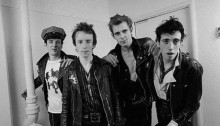
Radiohead: Pride cometh before the fall…
Pablo Honey: 4.5 stars
The Bends: 4.5 stars
OK Computer: 5 stars
Kid A: 4 stars
Amnesiac: 3 stars
Hail to the Thief: 2 stars
In Rainbows: 3 stars

Radiohead’s career trajectory resembles that of an old-time baseball slugger, before steroids fucked up the typical pattern of rises and falls. They started out with promise, honed their skills in the middle of their career, and then gradually fell off as they got older. In their prime, they demonstrated a flair for the dramatic that few have, but as they aged, they fell back into comfortable and less idealistic patterns. How old-school of them. It’s almost enough to make you pull out your dusty radio and rocking chair to listen to a game on your front porch.
Most critics see the band’s career differently, of course. Indeed, their latest release, 2007’s middling In Rainbows, confirmed two sad realities: that Radiohead have pretty much reached that U2/Bruce Springsteen plateau whereby music critics apparently sign a contract forbidding them from criticizing any aspect of their new music simply because it bears their marks; and that they’ve never been farther from their peak.
Back in the 90s, though, the young prospect made you vibrate with the excitement of what was to come next. Influenced by 90s alternative and early U2, debut album Pablo Honey works much better when most of the songs are played live. (That fact makes it difficult to rate—if I listen to all its songs in their studio versions, it has to be docked at least half a star.) Breakthrough hit “Creep”—at least when nailed live—is transcendent, a tough and moving anti-anthem on which Yorke’s lyrics (“I want a perfect body / I want a perfect soul / I want you to notice when I’m not around / You’re so fucking special / I wish I was special”) rewrite Ian Curtis for the crass and sarcastic (in other words, the 90s cohort). The song of high school for me, and I doubt I’m alone. “Prove Yourself” achieves similar success—“I want to breathe / I want to grow / I’d say I want it, but I don’t know how / … I’m better off dead” with another riveting melody.
Those aren’t the only songs of note, but the album’s lesser tracks reveal themselves as a band searching for its alternative niche. But Radiohead hit the big leagues with sophomore effort The Bends, its Joshua Tree; mainstream enough to garner widespread acceptance, it’s full of anthemic choruses and a deft push-pull between Yorke and guitarist Johnny Greenwood. The midsection sags a little, and it doesn’t sound as timeless as OK Computer, but it’s still an essential 90s landmark; the title track and “Fake Plastic Trees” hit cathartic instrumental explosions, and the drama is reined in wonderfully by tender ballads “High and Dry” and the sleep-inducing (in a good way) “Street Spirit,” on which Greenwood applies understated guitar texture at only the right moments.
They then proceeded to blow everyone’s minds with OK Computer, which frequently shows up in “Best of the 90s” lists. The guitars hadn’t yet disappeared, but everything sounds darker, denser, more paranoid, more colorful, more experimental, and full of that indefinable it. Many billed the album as a warning against technology and the future, but the real treasures lie in the intensely personal songs: “Exit Music” and “Climbing Up the Walls” are both legitimately haunting, while “Karma Police” unfolds with perfect pacing and genuine heart.
Yet nothing compares to “No Surprises and “Let Down.” The glockenspiel on the former almost achieves the same degree of I-still-remember-when-I-first-heard-it awe as those chimes on Joy Division’s “Atmosphere,” and lines like “I’ll take the quiet life, a handshake of carbon monoxide / With no alarms, and no surprises, please” make quiet resignation feel like the only valid option in the world.
Similarly, on the breathtaking “Let Down,” their all-time best song, Yorke captures that in-between feeling of despondency, confusion, and search for beauty that has been fascinating singers (such as Curtis) for years. His second-verse—culminating with “Don’t get sentimental, it always ends up drivel”—breaks my heart every time, but I’m lifted up by the gorgeous melody, the exquisitely placed guitar, and those heartbreaking, multi-layered vocals, spinning around from ear to ear over the conclusion. These tracks possess that rare form of intoxication found in songs like “One”—they achieve incredible emotional climax without ever making you realize it until afterwards.

“Radiohead’s response to all the acclaim,” Rolling Stone wrote, “was to get even weirder,” resulting in the electronica-heavy Kid A and Amnesiac. And that’s where the critical opinions start to diverge from my own, as most have seen such works as additional stops along the train ride towards revolutionary immortality. The former is the better album, RH still hanging on and providing otherworldly peaks like “How to Disappear Completely” and “Idioteque.” Yorke moaned “I’m not here / This isn’t happening” over end-of-the-world atmospherics, and then switched to a pulsating rallying cry of “This is really happening!” But the album couldn’t always keep up, introducing filler (despite the 10-track length) such as the irritatingly overlong “The National Anthem” and “Motion Picture Soundtrack.”
However, sister album Amnesiac begins the band’s real decline. Here, the atmosphere sounds somehow faded and less intense than Kid A, perhaps because the electronic sounds and keyboard tinkles have taken over for song-craft even more. There’s nothing as compact as the two aforementioned songs, so you have to enjoy the individual elements—the pretty piano on “Pyramid Song,” or Yorke’s provocative, repeated line “I’m a reasonable man, get off my case” on the opener. The album will work when you’re in the right mood, but that won’t happen very often. It’s not aggressive enough for the bitter and paranoid—on too many songs (“You and Whose Army?” “I Might Be Wrong”), you really do just want the band to let loose—nor does it have OK Computer’s sonic, lamentable beauty.
On the bloated and scattershot Hail to the Thief, though, everything goes ass. Here, the songs really only work if the piano sounds pleasing. But the band sounds like they’re trying to experiment just for experiment’s sake, to be difficult listening just to be difficult. Guitars feature more prominent than on the previous two releases, but the vitality of both Jonny’s axing and Yorke’s voice have been dulled, scraped off as though by a coin on a lottery ticket. In their desire to be different, they seem to have forgotten the necessity of qualities like melody, emotional release, or sonic agreeableness.
Tracks like “We Suck Young Blood” and “The Gloaming” skitter along electronic sounds that never break out of their shells—really, it’s incredibly boring, even though it may be sacrilege to say so. Radiohead seem to have settled into an unassailable niche, whereby one gets discredited as unintellectual and/or ignorant of quality music if he dares attack them. SPIN Magazine bucked this attitude with a recent feature challenging the notion that their every move sparkles with gold. Writing of a recent concert, they recounted, “Radiohead began their set with… “15 Step”: an open-ended groove with a quirky electro beat, two-chord motif, and airy, abstract singing. Then they did the 2001 song “Morning Bell/Amnesiac”: an open-ended groove with a quirky electro beat, two-chord motif, and airy, abstract singing. Then they kept going, one groovy tone poem into another…an immersive experience of sound, light, pattern, rhythm, and utter, paralyzing boredom.”
SPIN acknowledge that their opinion carries few supporters; indeed, the piece headlined an issue devoted to debunking popular rock ‘myths.’ And the pervasive critical adoration of In Rainbows (88 score on Metacritic) just confirmed the disconnect I now feel between popular perception of the band and my own. Rolling Stone’s 4.5-star review, describing the album as “typically hard-rocking Radiohead,” makes me wonder whether I happened to buy a different set of tracks from everyone else.

From refusing to play “Creep” live after it jumpstarted their career, to turning their backs on adored albums, Radiohead have never particularly seemed to mind pissing off their core supporters. And Rainbows, a hybrid of sorts between Thief and The Eraser (Thom Yorke’s solo effort released in 2006), proves they’ve completely forsaken the 90s. There may be nothing wrong with that in theory, but, no matter what Rolling Stone says, the album abounds with mellowness, but not in that epic, Cure- or old Radiohead-way.
Instead, songs like “Faust Arp, “House of Cards,” and “Reckoner” all project the same dull, taupe-colored mood—a new manifestation of boring, if you will. Yorke’s pet project, “Nude,” reminds me of U2’s “Sometimes You Can’t Make It On Your Own”—it was worked on for years and hyped by fans as the Next Great Thing, and yet it registers barely a blip on the radar screen. All throughout, a feeling of temperate melancholy dominates—and the apparent oxymoron of that statement explains a lot of my ambivalence about the album.
The band’s capabilities have now been reduced to providing calming tranquility, as they can do on “Weird Fishes/Arpeggi.” But if The Bends was a soaring flight over cliffs at sea, OK Computer a journey through an empty ocean, and Kid A a figure staring out over the cliff into the water below, In Rainbows is that person turned around, standing comfortably on dry land. Yorke’s lyrical concerns have shifted towards such mundane things as being a girl’s lover rather than friend and getting someone’s number at a bar (the admittedly neat “Jigsaw Falling Into Place”).
In other words, with the reduced diversity and increased simplicity of the music and more day-to-day lyrical concerns, Radiohead have struck new ground once again—but not on solid footing. On their best albums, Radiohead were never been easy to explain or understand, never created music that could pass without comment—good or bad—and never conveyed the feeling that they were content with themselves. Sometimes they were too weird or too overbearing, other times exceedingly brilliant, but they never felt satisfied—until now. And as the second half of their career has eschewed cathartic guitar rock for droning beats, prolonged songs that often don’t go anywhere, and vague wails that don’t resonate, it’s made me start to re-align their place in my musical pantheon. No longer a band who can do no wrong, they’re simply one that recognized extraordinary potential for a brief span of time, but then fell short of other ambitions. A sort of Michael-Jordan-playing-baseball thing, if MJ had been ‘only’ one of the game’s 2 or 3 best at his prime and baseball had accounted for about 40% of his athletic career.
As they’ve diminished both their muscular power and melodic grip, Radiohead have eliminated themselves as a band whose new album I’ll buy without hearing anything about it. And maybe I’m harder on efforts like In Rainbows and Amnesiac than I would be if they came from someone else. But the more I listen to their early work, the more I marvel at the specific emotion captured in a random, unhyped track like “Lurgee” or the masterful timing exhibited in the climax of “Fake Plastic Trees”; whereas, the more I listen to their later works, the less provocative they sound. In various parts of the latter half of their career, one can still hear Radiohead’s talent, but the overall impact leaves me thinking that a band that was formerly mine has left me behind.
