“Why are you the way that you are?” — Ten of my biggest writing influences

Every now and then I browse through the archives of Earn This — and my colllege newspaper columns, and my old personal web-site, etc. — and I usually come away some combination of pleased and disgusted. Pleased, in that my writing has become progressively more readable. Disgusted, and that so much of what I’ve written has been so bad.

I don’t claim that I’m a good writer, or even a competent one. I do claim, though, that I have gotten at least marginally better at writing than I was in 2002 as a freshman in high school. Part of that has been simple quantity of practice. Part of that has been ruthlessly critiquing my own writing, sometimes months or years after I’ve written it, and taking away some lesson from that analysis.

But what I want to focus on in this post is a third habit that has had a strong impact on my writing: Reading lots and lots of articles and books in areas that I write about, and trying to emulate aspects of writing that I enjoy.

This year is the tenth anniversary of when I started writing for fun, so I thought it’d be interesting to collect the ten pieces of writing or writers that have (by my guess) most directly impacted my own writing — especially for this site. Most are in a relevant genre; some aren’t. Here are my ten biggest written influences, and a brief explanation of why I like them and how they’ve impacted me.

[Read more...]

The Hit Equation

"The Manual" by KLF (1988)

Topping the UK charts is as easy as a² + b² = c².

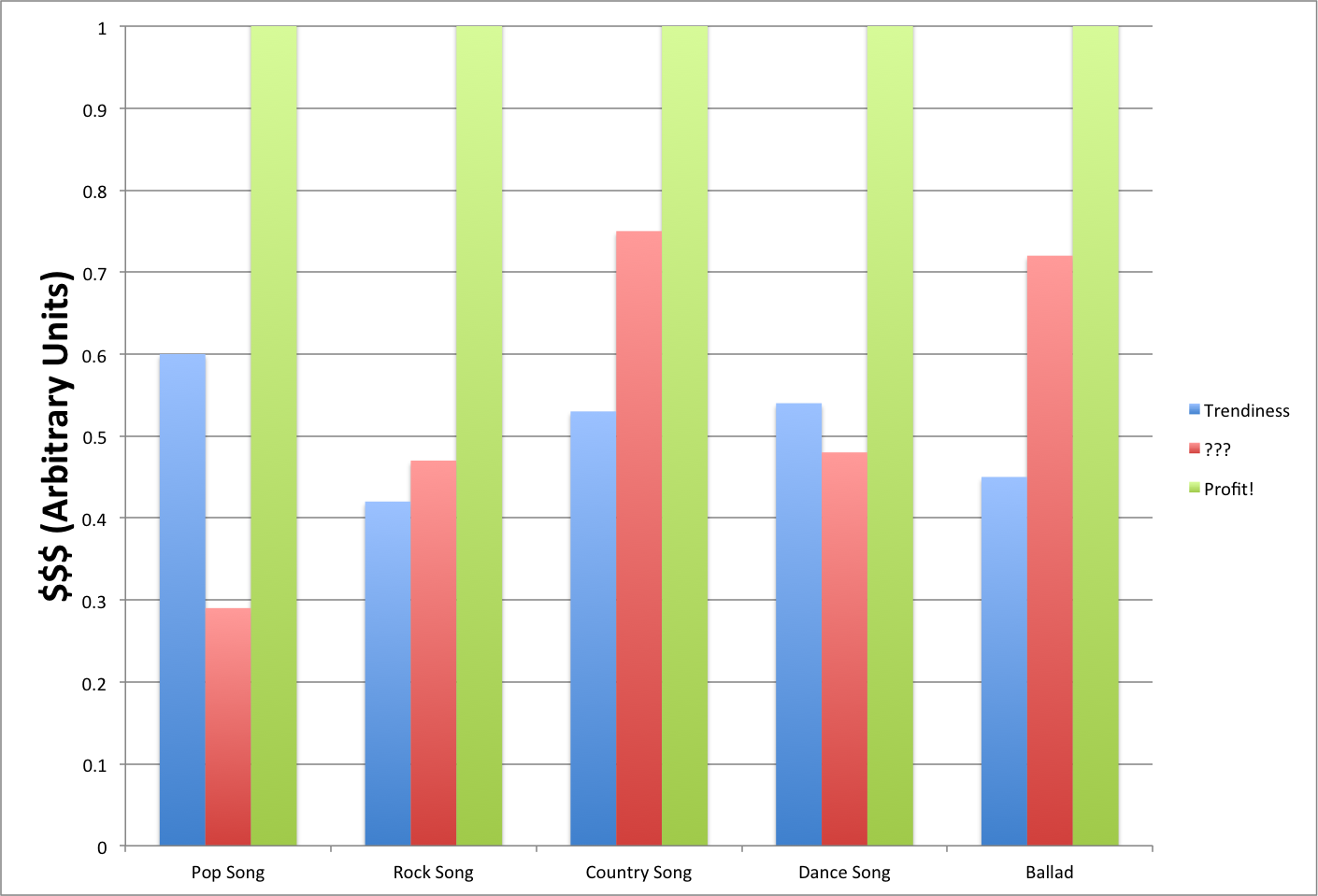
The Music Information Retrieval (MIR) team at the University of Bristol recently announced to the world that they had devised a mathematical formula that indicates what qualities of a song are important, and to what degrees, in determining whether that song will eventually make it into the top 5 spots of the UK Top 40.  Their research is on display in a very pop form at scoreahit.com.  And in the interest of fairness, you might want to take a glance at how they present themselves before you hear my opinions.

To me, as a lover of music and an acquaintance of the industry, the idea of an equation for success smacks of mythology.  While I recognize that claims of pop music becoming both formulaic and hit-driven are patently true, it’s just as true that not every cookie-cutter record becomes a worldwide bestseller.  I choose to believe that what separates hits from misses, if it is predictable at all, has little to do with song structure.  (It’s probably nothing noble either; I’m thinking along the lines of publicity funding.)

Press coverage, at least what the team links to, has uniformly been reminiscent of Bristol’s official release.  Maybe that’s a comment on journalism.  But, if you’ll follow me through the jump, I’d like to show you the problems I find with this particular study, its results, and its presentation.  In the process, I hope to completely maim your dreams about any holy grail of a Hit Equation.

[Read more...]

Eve 6′s Glorious Comeback is Nigh

Tell me if this sounds familiar: Pop/rock group makes a hit, gets unjustly labeled as a “one-hit wonder,” releases a dark and emotional masterpiece that witnesses the band crumbling, breaks up soon afterwards, disappears for years despite some generous re-appraisals of their later work, finally re-appears.

Trick question! I described (at least) two bands. Weezer famously vanished after Pinkerton. Eve 6, less famously, disappeared after It’s All In Your Head. The differences? First, Weezer disappeared for a mere five years. Eat your heart out, Rivers. Eve 6 is returning nine-plus years after It’s All In Your Head hit. Tomorrow, the lead single for their fourth album will be released. (You can already stream it here.)

Another difference, of course, is Eve 6 never made an impact the way that Weezer did. Eve 6′s fanbase, I’m sure, has remained devoted. But the band never gained traction the way Weezer did before their 2001 comeback.

Perhaps the biggest difference of all between Weezer’s much-talked-about return a decade ago and Eve 6′s imminent return is that Weezer’s comeback was… well… a decade ago. The music scene has changed drastically since then. Rock — especially rock by slick pop-rockers with a number in their band name — is out, way out.

So, why come back? What’s waiting for Eve 6?

Colton and I are waiting for Eve 6.

Of course, Colton — a good friend and fellow Earn This writer — has proven his allegiance to his beloved bands from late nineties and early aughts with his thoughtful consideration of the significance of Third Eye Blind’s Ursa Major. Many critics would have argued a comeback album from a band that many didn’t really miss didn’t even warrant that type of thought.

But comebacks are fascinating. They’re important to fans. They raise important questions about why we love music, and what is loyalty, and how much is it worth. I will have something to say when the day comes and Eve 6′s fourth CD hits shelves. Colton might, too. We did see an Eve 6 concert together, after all.

I had happily ignored all buzz about Eve 6′s return, but some details have leaked the past few weeks. It’s starting to seem like this return was made specifically for me, or at least people like me: we are the people who bought Eve 6 singles and albums long after the band disappeared, people who remembered the tiny band that could. To us, Eve 6 is a team of three men who helped us realize how quickly an unchecked life can sink to depression and emptiness. That’s the cycle of their three albums: guy feels lonley, guy has sex, guy feels lonely again.

And, occasionally, they reminded us that there’s something elusive and something meaningful that can be gleaned from all the toil. What were the last words they said to us before they confusingly disappeared, seemingly forever? “Pick yourself up off the ground.”

That final beat is a clever little wink, but it reminds me of a great line from another band I love, Relient K: “Nourished back to life by life alone.” Eve 6 didn’t really give us a reason to aim for a higher contentment. They just asked us to assume there was a reason, and pointed out what might happen if we didn’t make that assumption. Maybe they could teach us this because they were there themselves, “still here waiting” for that transient happiness.

All signs point to this long-delayed comeback being one for the fans, a follow-up to the career trajectory they rapidly fulfilled (rise-fall) a decade ago. Maybe they’ll crystallize some ideas that have brewing in our minds since they disappeared and give us a broad perspective of our lives. Or maybe they’ll just ask us to remember what we were when they said goodbye, to live in those past moments that Eve 6 has accompanied us.

If the lead single is to be trusted, Eve 6 will ask us to re-discover the complex, hurting aimlessness that they depicted so effectively in the early 2000s. It’s not that they want us to pretend we’re suffering the same ways we did ten years ago — just that they want us relate that suffering to the trials we tackle now. I’m okay with that. I’m excited to hear where Eve 6 takes me, what they make me feel and think. It’ll be an immensely personal journey, one that won’t make a major splash on the pop culture radar the way Weezer once did.

But it’s a comeback for me. It’s almost ten years in the making, and it’s one I’ll gladly share with the readers of this site when the time comes.


Who the songs on Taylor Swift’s Speak Now are about: a complete guide

Taylor channeling her inner Hilary Duff

I’ve been on a Bruce Springsteen kick recently (I think I could write a two-thousand word analysis on Rosalita alone), but occasionallyI need something more mindless and disposable. My recent pop album of choice has been Taylor Swift’s Speak Now, which has risen considerably in my esteem the past few weeks. It has a lot less filler than Fearless did, and her lyrics (all self-penned) are remarkably frank for teen pop.

Much has been written and discussed about the targets of a few of Taylor’s songs. She famously writes about her own love life in her hit singles. It got me wondering about the songs with less obvious targets, so I did a bit of digging. Turns out our little country daisy gets around quite a bit, particularly for someone who’s one album removed from a preachy chastity song.

Here is a breakdown of my findings. I hit some of the obvious resources — EW and MTV and People articles — but also braved SongMeanings.net, fan message boards, and — worst of all — Yahoo Answers. Fans have developed a consensus about the meaning behind most of the songs, though some are more obvious than others.

This exercise proves a little bit misguided and confusing at times. Taylor says she often writes about situations she’s imagined in her head with real-life people as characters in these hypothetical scenarios. Thus, Taylor writing specific feelings about a person or situation is not necessarily indicative of her real feelings. And even if every situation were literal, it’s all still speculation; she has adamantly refused to confirm the identities of most characters of her songs. She was kind enough to include some scrambled clues in her liner notes, and I’ve included those where appropriate.

[Read more...]

In which The Annie Awards lose all credibility

In the past I have praised the Annie Awards for providing a lens into the most important animated features from each year of the past couple decades. The largest mark against the awards came in 2008, when Kung-Fu Panda won Film of the Year against Wall-E, which was by far the most recognized and important animated movie of the year — and one of the most heralded of all time, for that matter.

My previous article alleges no clear culprit behind what was pretty objectively a poor selection. This year, it happened again: How to Train Your Dragon topped Toy Story 3. Now, I love HTTYD more than most, but Toy Story 3 is — by every important metric — the superior, more important film.

So what’s the story? It’s no coincidence the same studio released Kung-Fu Panda and HTTYD, and that studio didn’t have a film nominated in 2009 — the only year of the past three a non-Dreamworks film didn’t win. That’s right — Dreamworks used some sneaky tactics to win the awards.

Essentially, Jeffrey Katzenberg — chief overlord of Dreamworks and perhaps the most fascinating man in the history of animated film, though that’s a post for another day — saw a way to exploit the award selection system the Annie use. Basically, anyone who is a professional animator can buy a membership in ASIFA-Hollywood, the organization that votes for the Annie winners. (Fun trivia: ASIFA stands for Association Internationale du Film d’Animation, which is why everyone just calls them ASIFA.) Katzenberg pays for a membership for every one of his animators. Other studios do not; it’s up to the people who work there to decide whether or not to enroll.

So, surprise, the DreamWorks employees tend to vote for the films produced by the studio who employs them and pays for their membership. I don’t blame them. The limited oversight by the ASIFA has no real checks to prevent these types of shenanigans. Again, it’s not overt cheating — you can defend Katzenberg, in that he didn’t break any rules and didn’t (publicly) encourage DrewamWorks employees to vote as homers — but it also kind of is.

Pixar noticed this and decided to publicly boycott the Annie Awards. A cynic might argue that they chose this strategy simply because they have smaller numbers and can’t counter Katzenberg’s tactics. A Pixarphile would praise their devotion to integrity. I fall in the latter camp.

The result is that Annies have become something of a joke. It’s a shame; animation deserves a good awards platform. Buzz around the web sites I read is that the ASIFA is going to do something about it. Until then: we Pixar fanboys one more reason to mock DreamWorks (related)!

EDIT: Redemption?

Decade in Review: 10 Artists Who Have Dominated the Last 10 Years

Welcome to the teens! The aughties have reached their end and all of us who smugly ignored 2000 and celebrated the new millennium as 2001 rolled in are psyched about the new decade. Why? Because a new decade means that it’s prime time for retrospectives on the last decade! So, just in time for the Chinese New Year (shout out to all my fellow Rabbits!), I offer you a recap of those stars who have defined the past ten years in American music, those who are quantifiably the best and the brightest.

Yes, you read that right: my list is mathematically sound. All rankings are strictly by the numbers. Now, there are a great many statistics I could’ve used to compile the list. I have gleaned the record books looking for songs and albums matching any or many of these criteria:

  1. Spent at least 5 weeks at #1 on the Mainstream Top 40, based solely on radio airplay
  2. Spent at least 5 weeks at #1 on the Billboard Hot 100, based on a combination of airplay and sales
  3. Sold at least 3 million copies in the United States (“Triple Platinum”)
  4. Sold at least 5 million copies worldwide
  5. Was the best-selling album of the year in which it was released, as reported by Nielsen SoundScan
  6. Won a Grammy for Album of the Year, Song of the Year (for great songwriting), or Record of the year (for great performance in studio)

I have combined scores from each of these categories through a complex Sabermetric formula to produce a final score for each song and album, a score that I call the Coltonic Quotient. No, not really, but that would be pretty sweet, right? I just made a big graph of those six values and looked for artists who stood out. Enough with the exposition, let’s jump to the winners!

[Read more...]

The Office (UK) – Impressions from a fan of the American series

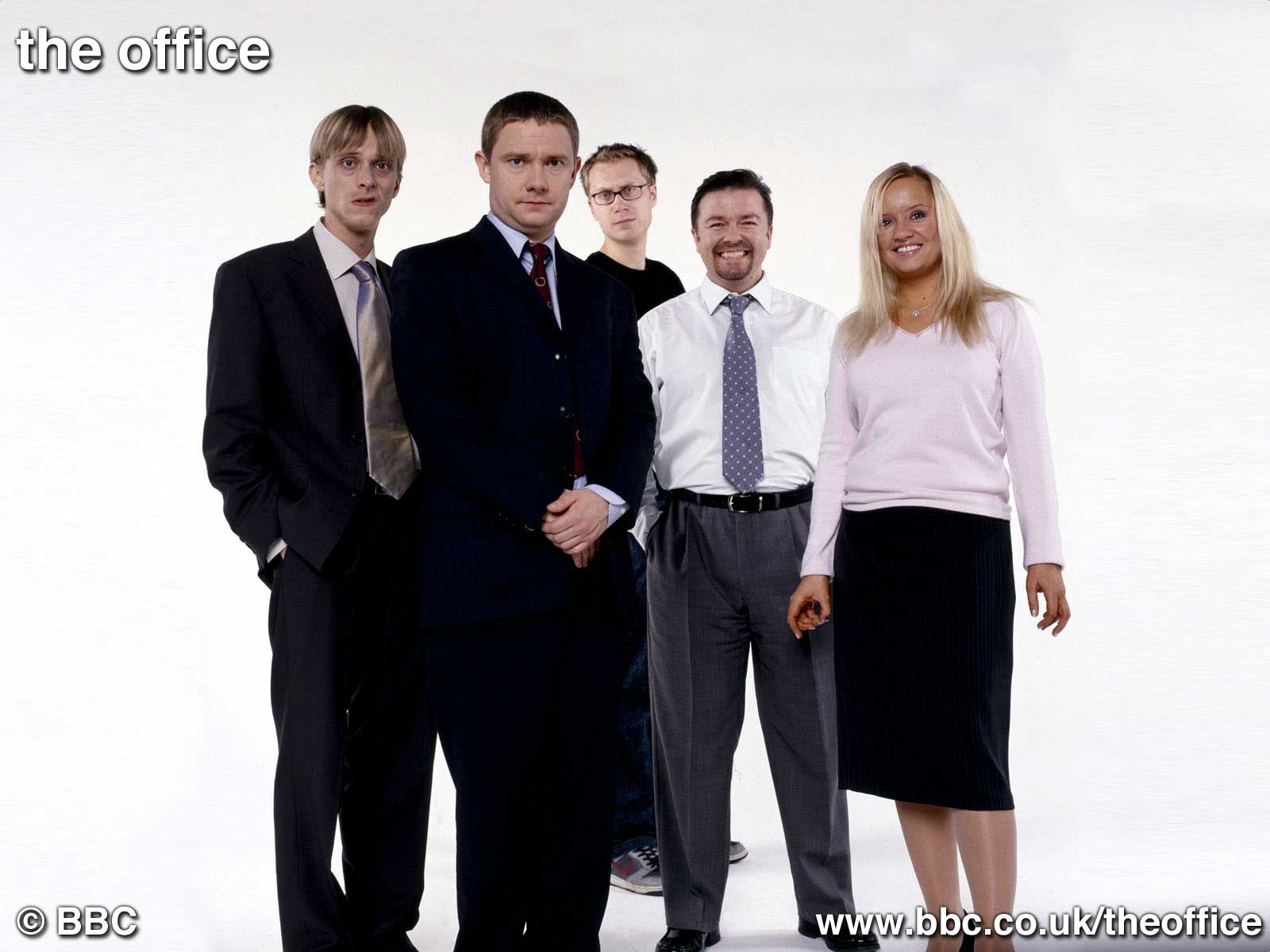
The U.S. version of The Office is my favorite show of all time (for a variety of reasons, all of which will be detailed in a post published probably some time around when this season’s finale airs). Yet, until this past week, I had never seen the British original. In the past five days, I’ve watched the twelve half-hour episodes and the feature-length series finale.

I figured there may be a few other fans of the American incarnation who have never traversed the British original. So here are a few spoiler-free thoughts on the the UK version of The Office from the eyes of a fan of the American version.

[Read more...]

What was the greatest decade for animated films?

vlcsnap-2010-07-15-17h34m24s249

This post is part of The Month of Animated Features.

Without thinking too much about it, what’s your gut answer to the headline?

Once you take a close look at the catalog of animated features released over the years, the answer becomes pretty obvious pretty quickly. First, let’s examine this question in terms of rigid numeric decades — e.g. “the 1950′s” would be eligible as a decade, but 1967-1976 would not be eligible as a decade.

Before I reveal what I believe is the clearly correct answer, let me go over how I evaluated each decade. As a reminder, I’m concerned mostly with enduring artistic quality and entertainment value, as opposed to issues separate from the product itself, like influence, technical innovation, or reputation.

[Edit: To reiterate, I'm focused exclusively on feature-length animation. I am not including animated shorts, TV shows, etc. This is especially important when considering the early decades in which theatrical shorts were very popular. While those are compelling in their own right, they are not relevant to this analysis. The logical flaws in this distinction have been argued, but I'm sticking with this constraint.]

Perhaps we should look first at the peak films of each decade. Generating a list of five of the best animated features from each decade should make it a little bit more clear which decades stand out as particularly weak or strong. We’ll start with the 1940′s, since that was the first complete decade with American-released animated films. (The movies are in no particularly order.)

  • 1940′s: Pinocchio, Fantasia, Bambi, Dumbo, and… umm… Bugville?
  • 1950′s: Cinderella, Lady and the Tramp, Sleeping Beauty, Peter Pan, and Animal Farm (UK)
  • 1960′s: Yellow Submarine (UK) and 101 Dalmations. Then… The Jungle Book? The Phantom Toolbooth? Sword in the Stone?
  • 1970′s: Allegro Non Troppo (Italy), Fritz the Cat, Watership Down, Fantastic Planet (Fr.), and Heavy Traffic
  • 1980′s: The Little Mermaid, Akira (Jap.), Castle in the Sky (Jap.), Who Framed Roger Rabbit, and The Secret of NIMH
  • 1990′s: Toy Story, Toy Story 2, The Lion King, Beauty and the Beast, and Princess Mononoke (Jap.) [just to have something non-Disney]
  • 2000′s: Wall-E, The Incredibles, Ratatouille, Shrek, and Spirited Away (Jap.)

Upon looking at those lists, there are a few obvious cuts. The 1960′s go out the door first, quickly followed by the 1970′s. The 1940′s have a tremendous top four, but thin quickly afterwards, so they have to go, too. The 1950′s, 1980′s, 1990′s, and 2000′s all seem worth consideration.

But if you start trying to come up with the five next best films from each of those decades, it becomes obvious two decades really warrant consideration for the top spot.

  • 1950′s: Alice in Wonderland… followed by… maybe the claymation cult favorite Hansel and Gretel? The Sword in the Stone? That’s about it.
  • 1980′s: My Neighbor Totoro (Jap.), Grave of the Fireflies (Jap.), Barefoot Gen (Jap.), The King and the Mockingbird (Fr.), and… that’s it?
  • 1990′s: Aladdin, Tarzan, The Nightmare Before Christmas, The Iron Giant, and A Bug’s Life
  • 2000′s: Up, Finding Nemo, Howl’s Moving Castle, Kung Fu Panda, and Monsters Inc.

So, assuming you want at least ten great-or-borderline-great films from whatever decade you choose, the only real contenders here are the 1990′s and the 2000′s. You could argue that I’m biased because that’s really the only time I was watching movies, but I think the lists back me up.

(Quick sidebar that will receive expansion later: There is a very compelling conclusion from this observation: Animated film has been better the past two decades than it ever was before that, period. This statement will probably bother some purists and historians — the ones who dubbed 1918-1960 the so-called “Golden Age” of animation.)

So, which decade of these two is it, then? Just looking at the ten films as the best from each decade, even if there were a few that I missed that you’d have chosen, it seems relatively balanced. So I will go through a few more bits of evidence.

  • Exhibit  A: The Annies — a set of annual awards given out for excellent work in animation — were instituted in 1991, when they nominated three films for Best Animated Feature. Starting in 1998, they expanded the nominations to four or five pictures, peaking with six nominations in 2009.
  • Exhibit B: The Academy Awards added the category “Best Animated Feature” in 2001.
  • Exhibit C: According to Rotten Tomates — if you count only movies with 20 or more reviews — the 1990′s had 12 animated films with a 90%+ critical approval, whereas 2000′s had 21 animated films with a 90%+ critical approval. If you expand this to all films with at least five reviews, the minimum required by RT for a movie to have a valid approval rating, then the 1990′s have 16 and the 2000′s have 28 with 90%+ critical approval. Bring this bar down to 80%, and the 1990′s had 29, while 2000′s had 58.
  • Exhibit D: On the IMDb poll, the 1990′s have 12 on the list of the 50 most popular animated films. The 2000′s have 21 on the list.

You could find reasons to ignore any one of these on their own, but the more you stare at the facts — and look at lists of films from each decade — the more clear it becomes that there was a serious expansion in the quality, credibility, and breadth of animation in 2000′s; this is evidenced by the number of popular films and the increased industry respect through more Annie nominations and the Academy Award category.

Look closely at which films were released when, and you have trouble finding great animated films in the first half of the 1990′s not produced by Disney. The Annie Awards in particular are pretty revealing. I can tell you with pretty strong confidence that Space Jam, Ferngully, Little Nemo: Adventures in Slumber Land, The Swan Princess, and Once Upon a Forest — all Best Animated Feature nominees — would have had a tough time being nominated in the 2000′s in any year. They’re decent, but not quite best-of-the-year material. For most of the 1990′s, it seems like The Annies struggled to find at least three options. (And in 1996, they didn’t even try — they just gave it to Toy Story.)

To spin it one last way, the weakest year for animation in the 2000′s was probably 2004, with 2003 not far behind. Only 1999 (TS2, The Iron Giant, Tarzan) from the 90′s definitively tops them. Every other year from 1990′s was weaker than every year from the 2000′s.

There’s just a richer, more diverse group of studios and film-makers using animation these past ten years than ever. The result is the strongest slate of animated movies, and it’s honestly not even close. Credit the 1990′s for reviving the medium and for providing what will remain some of the most cherished animated films of all time. But don’t let nostalgia for the Disney masterpieces plus the merely decent non-Disney fairy tales that filled theaters trick you into choosing it as a stronger overall decade.

So, to answer the question raised in the headline: the 2000′s (with the 2010′s projecting to at least match it) were the greatest, with the 1990′s taking silver, and the 1980′s taking bronze. That’s a nice upward trend that excites me about the next few years.

A question with a less clear-cut answer is “What set of 10 years gave us the best animation?” For this discussion, I will allow 2010. I know we’re only six-and-a-half months into the year, but 2010 has been so good for animation so far that this half year trumps most other full years.

So, there are two answers for which I think you can make a really good case: 1999-2008 and 2001-2010. The problem is that 1999 and 2009 were two of the best years ever for animation, and they’re just far enough apart that you can’t include both of them.

These two spans obviously have a lot of overlap, so let’s consider the films not included in both of these categories. From 1999-2000 — so in the first span, but not the second — you have Toy Story 2, The Iron Giant, Tarzan, The Emperor’s New Groove, Chicken Run, and Fantasia 2000 probably in that order in terms of significance. In 2009-2010 — in the second span, but not the first — you get Toy Story 3, How to Train Your Dragon, Up, Coraline, Fantastic Mr. Fox, The Princess and the Frog, Despicable Me, and The Secret of Kells.

Again, I’m hesitant to fixate on the present and overlook the past, but I have to side with the more recent 2001-2010. I can pretty confidently say that the past ten years have been the best overall years for animation ever.

Note: Perhaps you’re wondering why I included a frame from The Sword and the Stone, of the 1960′s. One reason is that Merlin’s looking ponderous, as appropriate for a post with a question for a headline. The other, more prominent reason is that I forgot to bring up the film in my overview of Disney during “The Golden Age” and wanted to give it some recognition. A glaring omission of a passable film. [Edit: Not true following my recent revision]

The Weirdness of the Cult-Hit Preschool Show, Yo Gabba Gabba

I have a little sister who’s about to graduate from pre-school, so my mom has seen the whole spectrum of kiddie TV shows. When I asked her to describe Yo Gabba Gabba in one sentence, this is what she said:

“It’s what I imagine LSD flashbacks must be like.”

The surreal Nickelodeon show is about dancing and singing and grooving. The average episode features a bunch of songs with gratingly simple beats and shout-along melodies. While the show has been a hit with pre-schoolers, winning the little-kid demographic at its time slot (if not trumping juggernauts like Dora the Explorer), the show has developed considerable buzz as a hipster favorite, in large part because of some points my mom was touching on: its phantasmagorical absurdity and straight-faced wackiness.

Yo Gabba Gabba that taps into some of the most primitive reasons we watch moving pictures: shapes and sounds and rhythms and colors. My goodness, the colors: As you can tell from the picture I decided to include, Yo Gabba Gabba stretches across the rainbow and saturates everything. It’s bright and fun and, as main “character” DJ Lance Rock, likes to say, it’s “awwweeeesoooooooomme!”

Another key to the show’s popularity with the young twenty-somethings is that it’s been a fertile ground for inspired guest starring. The pilot featured Biz Markie in “Biz’s Beat of the Day.” Though he’s best remembered for his semi-novelty track “Just a Friend,” in which he whines and wails, Biz Markie has slightly more cred as a funny freestyler and beatboxer.

Markie threw himself into the role so unabashedly, and fit the vibe of the show so well, that it really worked and set a precedent for having stars of various caliber on the show acting like they really want to be there and make kids get up and move. Another representative example is Elijah Wood, who is not only a random enough celebrity to be cool and unpredictable, but is introduced as “Elijah,” not “Elijah Wood, star of upcoming animated film 9, coming to theaters this September!”

Most celebrities on Yo Gabba Gabba are there just for the fun of it, not for self-promotion, which adds to the charm. There’s no sly references to the guest’s real life persona or even acknowledgment that anyone is famous or notable. It’s just someone else to sing a “Dance-y Dance” song.

Here’s an incomplete list of guest star appearances. I love how eclectic the collection is:

  • Biz Markie
  • Fashion designer Paul Frank’s Julius the Monkey
  • Andy Samberg
  • The Aquabats
  • The Aggrolites
  • Hector Jimenez
  • Smoosh
  • Devo
  • Sean Kingston
  • Tony Hawk
  • Shiny Toy Guns
  • Rahzel
  • The Shins
  • Melora Hardin (actress from The Office)
  • Jack McBrayer (actor from 30 Rock)
  • Jimmy Eat World
  • Hot Hot Heat
  • The Ting-Tings
  • The Roots
  • Jack Black
  • Weezer
  • MGMT
  • “Weird Al” Yankovic
  • Sarah Silverman
  • Black Kids
  • of Montreal
  • Mos Def
  • Mix Master Mike (of the Beastie Boys)
  • Solange (Beyonce’s little sister)

Pretty impressive list, huh? Many of the more high-profile appearances have come in the past  several months. I doubt it’ll be long before Jay-Z or Tom Hanks makes an appearance. I’m not the only one to have noticed the strange popularity of the show. The hipsters’ fixation, like the show itself, is quite amusing and worth keeping an eye on.

Relient K – Forget and Not Slow Down (2009): More backstory, more catharsis

rkmattrkshan

This is part 8 of the Relient K retrospective

(I wrote a review of Forget and Not Slow Down about a week ago. Since then, I’ve been doing some research on the album’s origins, and I believe the results make it much more moving and devastating.)

I generally like to keep my nose out of other people’s business, but because  Forget and Not Slow Down is such an emotional album, I figured it could be valuable to try and figure out what events caused these emotions to better relate to its often abstruse lyrics. My poking around was not in vain. Here’s the story, as I understand it, but feel free to disagree with my speculation and assessment. I’ve linked to all the sources I used in reaching my conclusions.

Back story:

Matt Thiessen is generally known as one of the nicest dudes in music. He takes his Christianity seriously. Everyone was thrilled when he proposed in a most adorable way to radio host Shannon Murphy. She used her blog to keep her friends, and the world, updated on their engagement. But a few months later, she revealed that the two had split after she discovered “a few things about Matt that I just simply could not handle,” though she noted that she still believes he has an “amazingly huge heart.”

The break-up went down pretty quietly until Murphy got a new gig and started talking about an ex-boyfriend who cheated on her. Though she declined to use a name and vocation to identify who she was referring to, people made the connection.

Towards the end of the next year, Relient K’s sixth studio album came out. Thiessen says he wrote it when we went to a cabin in the woods for a couple of months to do nothing but reflect and pray and write. Forget and not Slow Down was the result, and it came out to pretty strong critical acclaim, with few media sources rating it worse than 4 out of 5 or the equivalent.

On the morning of the release on Shannon’s radio show, she directly implicated implicated [edit: this link is dead, I'm looking for another version of it, because this is the crucial piece of the puzzle] him as a cheater, although she noticeably avoids saying anything else negative about him. She also reveals some tidbits that add some serious poignancy to the album: the couple always used to travel to Savannah, GA — and there’s a song on the album called “Savannah.” Perhaps most devastatingly of all, “Baby,” a 40-second outro to Savannah, was the song Thiessen originally wrote for Murphy to play to her at their wedding.

Over the next few weeks in interviews, Thiessen frequently expanded on the album’s meaning, though he declined to delve into specific details regarding his personal situation. Of course, some fangirls refuse to believe Murphy is telling the truth because Matt is, like, so amazing. Others have taken a more reasonable view that neither of them are saints, and it’s pretty clear Matt likely betrayed her trust in some way, and they were not a perfect match anyways.

I suppose it’s theoretically possible that she’s completely BS’ing and slandering Thiessen, but he’s never really disputed her claims of adultery, and a few passages in the album more or less confirm her claims. So how does this information affect the listener?

Re-interpretation

More than anything else, these details of Thiessen and Murphy’s break-up make Forget and Not Slow Down a personal and powerful album. My initial reading of the album was as a broad, over-arching look at the concept of saying goodbye and pressing on. But, after hearing Murphy talk about the album, I think there’s a lot of value in the album as a reflection on their specific relationship.

If Thiessen in fact perfidiously caused the end of his relationship, then the words of the album carry much more weight — particularly considering his saintly public image before the scandal broke out. I think there’s something poignant and ironic about the leader of the most spiritual and positive of bands committing an act of great betrayal, then having to dealing with the consequences. It gives the album very high emotional stakes and some genuine substance.

Other great RK albums have been reflective and regretful, but on smaller levels. Forget and Not Slow Down is paradigm-smashing for the band in its gravity. This was evident to a certain extent when the I interpreted the album broadly, its songs as abstractions. But, with this new backstory, it’s clear that never before has Relient K been so acute, specific, and painful. The album works much stronger as a look at Thiessen’s specific shame and regret and recovery than as a detached meditation of these concepts.

A few of the most telling passages:

A lion on his side, was it the lying or his pride which brought him down?
Once the king of beasts, but now they feast on the thoughts beneath his vacant crown
Trying to decide, was it the lying or the pride which brought it down?
To be alone, to be dethroned, believe me I know all about it now
from “Sahara”

This passage works as a general image of pride and sin, but works especially well considering the scandal and isolation surrounding Thiessen’s life. As the king of Christian rock (in terms of both quality and mainstream success), and one album removed from his biggest and happiest album, he sank to his lowest, and he’s still not sure if it was “lying or his pride which brought him down.”

Baby
It’s all that I can do to
Thank you
Cause every time you wrapped those arms around me
I felt I was home cause
Everything made sense when you were with me
from “Baby (Outro)”

Tossed off as an outro, I dismissed “Baby” as generic post-breakup pining until I learned the song’s origin as the song Thiessen wrote for Murphy to play at their wedding. What a harrowing inversion of the song’s initial concept: a bittersweet farewell at the abrupt conclusion of their relationship instead of at the beginning of their marriage. Thiessen has said in interviews that recording this album was overall a positive experience, but I can’t imagine that was true for “Baby.”

I’d rather forget and not slow down
Than gather regret for the things I can’t change now
If I become what I can’t accept
Resurrect the saint from within the wretch
Pour over me and wash my hands
from “Forget and Not Slow Down”

“Resurrect the saint from within the wretch” is the key line of the album, I think. It best sums up the album’s tone: regretful and defeated, but still looking for the right way to respond. He doesn’t shy away from the fact that he did something wrong, but he considers that the most therapeutic option is to move on rather than linger on his guilt. There’s also some nice imagery of absolution there (“Pour over me and wash my hands”) which reflects a lot of passages in the Bible.

I met the devil and I stared her in the eyes
Her hair had scales like silver serpents
I, a statue, stood there mesmerized
I took the fire escape and made it out alive

Yeah I still burn from time to time
But I’ve a healing hand against my side

Blisters on my feet I crawled back home
Frozen from the sleet, burned sand and stones
Nourished back to life by life alone
With one shake of the mane regain the throne
from “(If You Want It)”

These are the closing lyrics of the album, and they’re most beautiful Thiessen’s ever written, in my opinion. That first stanza is about as poetic and archetypal as any admission of guilt, and he follows it up not only with a re-affirmation of faith and healing (second stanza) but that dazzling coda. Those last four lines call back the lion image from “Sahara.” They also present an idea unusual in the modern rock-and-roll landscape, which tends towards angst and self-deprication: That the very act of living, even in misery, is valuable.

That’s how Forget and Not Slow Down is still a distinctly Relient K album, even as it confronts a major transgression by the band’s leader: It stays rooted in optimism and an a love for life more unquenchable than ever.

Revised rating: 4 and half stars (out of 5)