
Shutter Island: Live as a monster or die as a good man?

shutter island

Rating: 4 stars (out of 4)

In a revealing late chapter of Harry Potter and the Deathly Hallows, Harry asks Professor Dumbledore whether their poignant interaction has been taking place for real or merely in his head.  “Of course it is happening inside your head,” Dumbledore responds, “but why on Earth should that mean that it is not real?”

Leonardo DiCaprio’s character in Shutter Island personifies that sentiment—all its heartening and worrisome consequences—perfectly.  We might not agree with it at first, but the more you think about this movie, the more it makes sense, after your brain is melded, stunned, reversed, reversed again, and invigorated.  Filled with disturbingly bone-chilling moments the likes of which few movies possess, Shutter will mess with your mind, and then it will leave you in feverish contemplation of its ideas.  There’s one jolt after which the audience jumped more noticeably than I’ve ever seen before in my life.  It made a (female) friend cry extensively, made a (male) friend turn to me repeatedly to tell me how creeped out he was, and left me, like all my companions, legitimately clueless of what was going to happen in the climax—a staggering, and incredibly rare, combination of forces.

And then, afterwards, it’s provoked hours of discussing amongst everyone I’ve seen it with.  Given potential by Dennis Lehane’s book (the man behind only Mystic River and Gone Baby Gone), director Martin Scorsese, his cinematographer, composers, and actors transform it into something enduring.  If movies are designed to arrest the senses, to provoke extreme emotions, to force examination of thoughts and feelings that might not otherwise be considered, then it’s clear why Shutter Island will be repeat viewing for anyone who sees it.

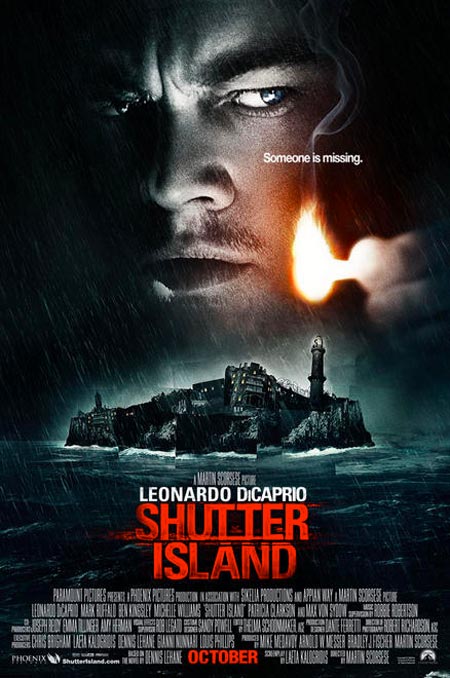
Set in 1954, with Communist paranoia as just one component of dread, Shutter teams Scorsese up for the fourth time with DiCaprio, who plays U.S. Marshal Teddy Daniels.  He and his partner Chuck Aule (Mark Ruffalo) have been assigned to visit Shutter Island, an ominous piece of rock off the coast of Boston Harbor that houses a mental institution for the criminally insane.  Teddy and Chuck were sent to investigate the unexplainable disappearance of one of the inmates, Rachel Solando, who, we are told, lives in denial over her murder of her three children.  Teddy and Chuck are assisted, to an extent, by the facility’s head doctors Cawley (Ben Kingsley) and Naehring (Max von Sydow), and the actors’ (particularly Kingsley) strike the perfect balance between creepiness and kindliness that only muddles our perceptions even more.

Before long, we discover that Teddy stalks the island for reasons beyond Rachel’s disappearance, but we’re not sure exactly what they are.  Is it because he’s trying to uncover evidence that the seemingly good-natured psychiatrists are actually performing mind-altering experiments on their human patients?  Is it because his past—deaths within his family, wartime trauma—compelled him there, perhaps in search of another patient?  Will he ever make it off the island, and if not, will it be because the doctors refused or because he legitimately didn’t belong anywhere else?  Just how much can we believe him?  Or are both parties not to be trusted?

Scorsese embellishes these feverish questions with a dazzling array of sights, sounds, and visual tricks so absorbing that you’ll probably be having dreams about them afterwards—and not pleasant ones.  Teddy’s own disturbing nightmares about his dead wife and his past begin to overlap, more and more, with the missing woman and what we perceive to be “reality,” to the point where we stop being able to clearly identify what exactly is happening.

And when you leave Shutter Island, you’ll wrestle with your inability to state exactly what “happened”—both because that question can’t really be answered without reference to specific characters’ perspectives and because Laeta Kalogridis’s script doesn’t have any interest in giving you a simple resolution.  Is there actually a ‘twist’ in play, or not?  Reviewers seemed perfectly content to accept the plausibility of the apparent twist, but after countless hours of reflection and discussion with others, I have too many doubts.

Moments like Ruffalo’s final spoken word, Cawley’s dubious claim that they’d broken through to Teddy 9 months previously, and the overstatement of the heinous nature of Teddy’s crime by Cawley pushed me towards thinking that he’d really only been there for 2 days.  The parallel seemingly drawn with the older woman who killed her husband in somewhat-believable circumstances seemed a crucial indictment of the institution as well, as did a few things Cawley said that didn’t seem compatible with the presumed twist.  But almost everything here can be taken as evidence for either perspective.  Ruffalo’s word could have been part of Teddy’s delusions.  And—critically—there’s acting involved either way; either the institution was involved in a dramatic ‘role play,’ or everyone was trying to push Teddy further into paranoia in order to paint him with that brush.

In fact, that confusion is PRECISELY the point of Shutter Island: how fine the line is between the sane and insane.  If you were insane, would you know it?  Did Teddy know it?  Who can say?  And, the movie proposes, couldn’t anyone could be insane and not know it.  If you were painted as insane, would you accept it?  Or would you think you’d been mis-characterized?  And doesn’t Teddy truly personify the concept that (in)sanity isn’t an all-or-nothing proposition?

Philosopher Renee Descartes formulated the famous “Dream Argument,” the notion that, since during dreams we are unaware of their fakeness, what we consider our normal lives could, analogously, all be a dream, could all be manipulation and deceit.  Of all the creepiness and shocks in Shutter Island, that’s the most discomforting thought—that anyone could either a) painted as insane or b) actually be insane.  That’s why the mind-melding of the movie’s tricks works so well on us, just like in A Beautiful Mind; we’re feeling what he is.  Who’s insane, and who’s to determine that?  Was Teddy unable to completely hate his wife because he saw that he could have easily been turning into her?

Shutter raises all these questions pointedly, creepily, coldly efficiently: how resilient and smart was Teddy, and how capable was he of being manipulated?  The film makes numerous references to his intelligence, as if to ask: under certain circumstances, is it ‘smart’ to be insane?  The comments from various patients who expressed no desire to leave the institution out of fear that the outside world had passed them by sounded remarkably forward-thinking.  So was Teddy’s ‘decision’ to create an alternate persona for himself evidence of insanity?  Or did it enable him to lead a more stable, productive life?  And was it smart that, whether or not he was acting with his final comments, he wanted everything to end?

But even if Teddy had accepted his fate, isn’t it the case that the institution had won, that he was doomed regardless?  And if you thought anyone could be insane—including yourself—wouldn’t you oppose the thought of authorities declaring who was?  The island is so close to Boston, but it may as well be a million miles from anything.

Wow.  How often does a film make the most of everything from its opening shots—the shrewd symbolism of showing DiCaprio’s face through a mirror and then straight on, highlighting his dual personalities—to that infinitely fascinating final exchange, wrapping up everything and nothing all at once?  In an age when movies are made with such extreme caution, with such an obvious desire to appeal to the least common denominator, Shutter Island explodes as a maverick, structurally, thematically, visually, emotionally.  After each viewing, I haven’t wanted to do anything (other than talk about it), sometimes just driving or walking around aimlessly, lost in contemplation and well aware that I wouldn’t be able to focus on anything else.  After my first two viewings—on the same day—I was convinced it was an outstanding movie, and my feelings have only intensified since then.

Amidst all the discussion it provokes about sanity, instability, knowledge, and uncertainty, the most important take-away message might be that the true dangers in the world come not from external sources to which we apportion blame, but from within, from our own terrors and uncontrollable urges.  Teddy, we can gather from skillfully placed background information, couldn’t deal with his wife’s demons because he was too occupied with his own, and he couldn’t deal with his own because he wanted to fear and blame something outside of him.

Just like The Bourne Ultimatum, Shutter Island has become the latest feverishly-anticipated movie that nevertheless blew me away.  It will without question define my senior year of college and 2010 in general, and for many years in the future it will become one of the first “Have you seen…?” questions I ask people when the conversation turns to movies.  Despite the fact that it’s more of a short-story than a novel, really, and that it unashamedly flaunts its creepiness, it has virtually nothing that’s not exceptional.  There’s DiCaprio, masterfully portraying Teddy’s ‘descent’ into insanity, a performance that just gets better the more you know about his character.  There’s the seemingly endless debate and discussion it provokes, both about its involuted storyline and the philosophical issues it raises that relate to us all.  And there’s that visceral intensity, that psychological gut-punch, that ferocious look on DiCaprio’s face that keeps telling us there’s even more to see, more danger around the corner, more mysteries of the human mind yet to be uncovered, more depths of cruelty yet to plunge.

The Departed: Gangsters and cohesive plots are both lost

Departed

Rating: two stars (out of four)

It’s not hard to see why The Departed drew such strong acclaim.  It features a well-known cast of actors, even down to the nominal supporting roles, and is directed by a Hollywood favorite, Martin Scorsese.  Its plot concerns the well-mined territory of mobsters and cops facing off against each other, and the screenplay sparkles with some witty dialogue and clever insults.  Yet something feels terribly off here: though it’s intriguing and endlessly entertaining, it doesn’t feel like much of a movie in retrospect.  Repeated viewings reveal not just plot holes but plot impossibilities; and the movie, laced with flippancy and levity, doesn’t seem to take itself seriously enough for its subject matter.

A remake of the 2002 Hong Kong movie Infernal Affairs, the movie centers on the Massachusetts State Police Department’s Special Investigations Unit, headed by Captain Queenan (Martin Sheen), and its attempt to thwart a gang headed by Frank Costello (Jack Nicholson).  The set-up is loaded with promise: each group has infiltrated a mole into the other’s inner circle.  Billy Costigan (Leonardo DiCaprio) grew up around nothing but criminals.  Perhaps because of this, he wants to be a cop, but Queenan and his second-in-command Dignam (Mark Wahlberg) decide that his background makes him a perfect fit to be a mole inside Costello’s circle.

On the other hand, Colin Sullivan (Matt Damon) was raised a proper church-goer on the good side of town; perhaps because of this, he’s susceptible to Costello’s fatherly guidance during his youth.  Costello grooms Sullivan from youth to be his mole within the police unit (one of them, anyway).  The bulk of the movie follows DiCaprio and Damon trying to oust each other before they’re found.  In the meantime, Damon’s Sullivan is appointed as the internal affairs cop within the SUI, being asked to look for Costello’s mole—to find himself.  A psychiatrist named Madolyn (Vera Farmiga) gets involved with both men and further entangles the plot.

The potential for a great movie is here, but The Departed doesn’t deliver on its promises.  Its weak script is manifest in an overly flippant tone and terrible plot holes.  The film is far too slick for it’s own good, failing to achieve any level of gravitas.  It’s more concerned with telling us how funny Mark Wahlberg is, or how outrageous Nicholson’s props are, and it’s impossible to take The Departed seriously when it is so amused with itself.  It’s no coincidence that it couldn’t have taken place without present day technology (such as text messaging), because it reflects present culture’s fascination with overly-stylized, soulless, superficial products, ranging from TV shows to music to movies.  Yet everyone, from critics to the general public, mixed up the slickness and the comedy and the violence into a blender and assumed something pure came out.  Oh, look, Captain Queenan just fell hundreds of feet to his death, aren’t Martin Scorsese films just so gritty!

We live in an age when a movie can succeed with a few demonstrative moments even when it does very little thinking, because apparently audiences don’t care if a stiff breeze would collapse the plot.  Why, for example, does Sullivan make secret calls to Costello while walking through the halls of the police headquarters; and why does Costigan make secret calls to Queenan just a few feet out of range of his comrades?  How does nobody hear the numerous gunshots occurring in the showdown between Sullivan and  Costello until the former announces their whereabouts, and why was he even allowed to go after Costello alone?  I couldn’t really buy Costigan’s first defiance of Costello (leading up to his tryst with Madolyn), or the fact that the Chinese would have let Costello get away with his swindling.  But I was probably the most annoyed by the potentially fascinating street chase between Costigan and Sullivan fizzling into nothingness because the former’s phone rang to announce an incoming text—when he had just minutes before been receiving texts that caused the phone to vibrate.

Scorsese pumps the movie full of energy and color, which at times works to its advantage, as it’s endlessly watchable and full of some riveting scenes, such as the sequence leading up to Queenan’s death and the ultimate rooftop confrontation between Costigan and Sullivan.  Other times he tries too hard, as evidenced in the overly frequent use of music that likes to cut off sharply to make a point.  But it’s William Monahan’s script that truly sinks the film and makes it leave a bad taste in your mouth afterwards.

The script lays things out nicely enough at the outset, but it does take a while for the energy level to really rise, and the character development throughout leaves a lot to be desired.  Madolyn’s relationships with the two men don’t ever boil over into anything substantive, which is a shame, because, if nothing else, she represented a solid opportunity to flesh out their characters.  The film has to ascribe impotence to Sullivan to enable her to become interested in Costigan—an unlikely story, to be sure—and when she walks away from Sullivan in anger at a funeral, the film misses the obvious chance for her to deliver a devastating line.  And when Sullivan tells Costello that he’ll succeed at a task because “it involves lying, and I’m pretty good at that,” the line sounds so off that one suspects that its inclusion must only predict Madolyn later hearing it.

Elsewhere, as the film accelerates towards its climax, it is indeed intriguing to watch Sullivan try to make legitimate attempts to find the mole hidden within SUI.  But, too often, the film has to resort to its characters acting stupidly for things to fall into place.  Costello, for example, is way too naïve in his attempts to figure out Costigan’s loyalties: he foolishly assumes that if Sullivan hasn’t heard something in the office, Costigan couldn’t have given away his secrets, a particularly narrow-minded attitude especially considering that Sullivan knows that Queenan refuses to divulge any information about his undercovers.

On and on the contradictions go, particularly in one titillating but frustrating sequence wherein Costigan has his therapy session and flashes back to a meeting with Queenan and Dignam under a bridge.  You want to revel in DiCaprio’s acting and the sharpness of his words (“Two pills?  Great…why don’t you just give me a bottle of Scotch and a handgun to blow my fucking brains out!  Are we done with this psychiatry bullshit?”) but Farmiga’s struggles to find realism throw some cold water over the dream state.  And you can’t enjoy the encounter with Queenan and Dignam because of Dignam’s idiotic threat to erase the only proof remaining that Costigan’s a cop—as though you would say something like that to someone whose dangerous undercover service you wanted to continue.


DiCaprio and Damon clash in the film's best scene.

DiCaprio and Damon clash in the film's best scene.

The film’s acting garnered the same effusive praise that the whole film did, but it’s uneven.  Farmiga looks awkward and out of her league as Madolyn, but a lot of the supporting characters do fine work, namely Alec Baldwin, Sheen, and Ray Winstone (as Costello’s number one).  However, two pivotal characters grate.  Wahlberg’s Dignam delivers a few amusing insults (“I’m the guy who does his job—you must be the other guy.”) but by the end, both the character and the performance remain so one-dimensional it almost becomes caricature.  There’s an irritating scene where Costigan is trying to talk to him from an airport about something constructive, and he can’t do anything but blow him off.

And Jack  Nicholson, though he looks the part, is so over-the-top that he’s wholly unbelievable.  Nearly every line and ridiculous facial expression (note the mimicking of a rat) Nicholson delivers with Oscar-seeking relish—he’s far more Nicholson, with all of his patented showiness and egotism, than Frank Costello.

Amidst all this, there is one redeeming aspect: Leonardo DiCaprio, who bumps it up a half-star or so.  Costello may be the brain of the movie, but DiCaprio is the heart.  DiCaprio’s Costigan slowly unravels over the anxiety his double life causes him, and he is so fantastic that you don’t stop to wonder how good he could have been if Nicholson (or Farmiga) had shown up.  Costigan’s tough on the outside, and he’s tougher on the inside than you might expect shortly into the movie.

DiCaprio unearths all the subtlety in a startlingly loaded, blistering performance.  In my review of The Basketball Diaries, I wrote that DiCaprio was “so good, it’s frankly a little scary,” and it’s the mark of a great actor that with each role he expands his repertoire and just gets better and better.  DiCaprio is so riveting here that he tops everything he’s done before, even his outstanding turn in Blood Diamond.  He officially grew up in 2006; no longer the impossibly young-looking teenage boy who melted girls’ hearts in Titanic or felt Robert De Niro’s wrath in This Boy’s Life, he’s now a man.

Sadly, Colin doesn’t measure up to Costigan, for various reasons.  He’s not nearly as interesting or well fleshed-out as Billy is.  Often, indeed, the motivations for his actions are unclear.  Is he, for example, truly evil, or has he just been brainwashed since a young age to protect Costello from getting caught?  The film doesn’t bother to investigate.

Damon, for his part, is effortlessly natural in his scenes with Madolyn, but too often something felt a little off with him—his mannerisms a little too histrionic, even a little feminine.  When pressed into fierceness–as in the rooftop scene–he knows what to do; but on the whole this has to rank as a disappointing turn from one of my favorite actors.

The Departed, as a whole, has lots of style and little substance—and the truly disappointing fact is that the movie doesn’t aim for any more than that.  DiCaprio brings the necessary gravitas, but most of the film doesn’t.  It’s just the kind of movie Hollywood loves these days, but in the end it’s just full of sound and fury, signifying nothing.