

Dec 23 2010

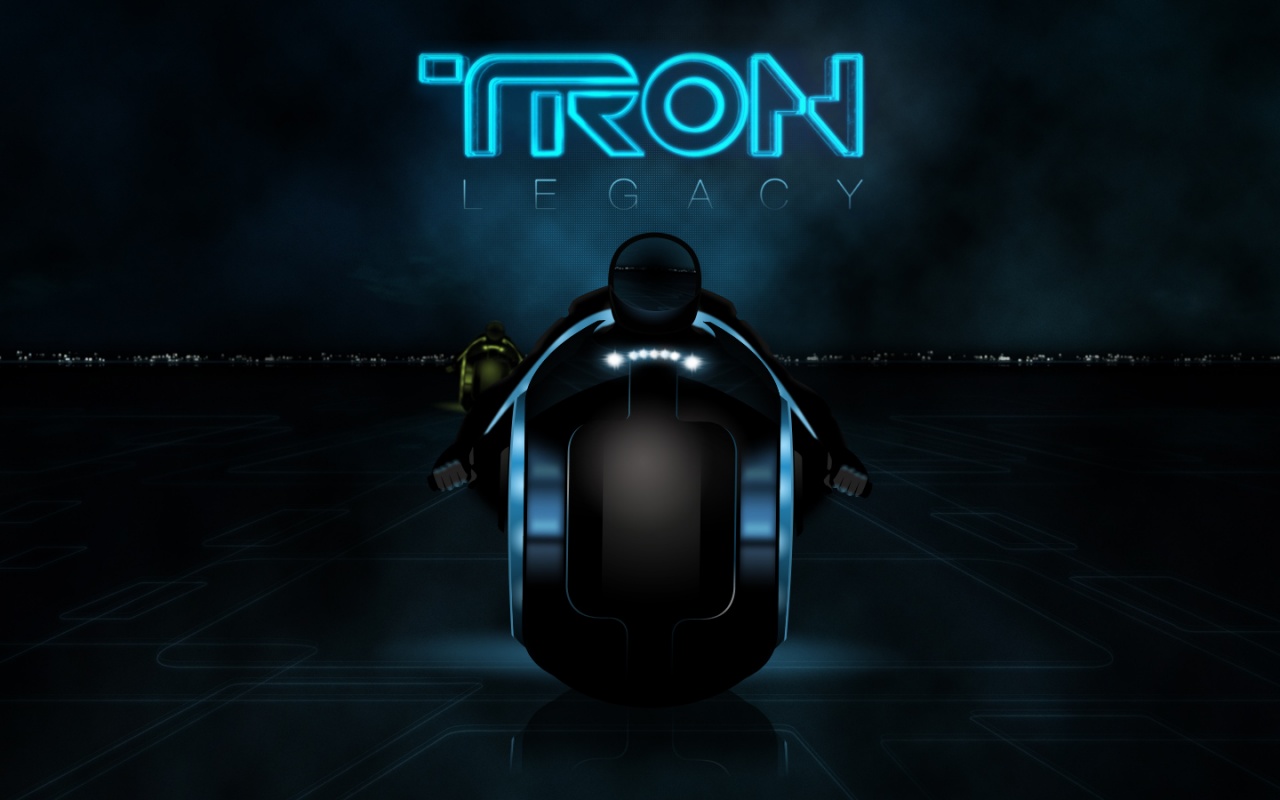
Tron: Legacy (2010): The Game Has Changed, Like, A Lot

Hunter T.

Tron: Legacy (2010)Rating: Two and a half stars (out of four)

It’s hard to imagine what it must have felt like to be there in August 1939. When Dorothy first left the flat, gray landscapes of Kansas and stepped into the vibrant land of The Wizard of Oz, theater audiences went with her, and they discovered a world unlike anything they’d seen on a screen before. Talkies were commonplace by then, and even three-process Technicolor had seen its fair share of use, but the effort that went into realizing the full potential of both resulted in an Oz that must have felt astonishingly real, and above all, new.

In the way that it showcased the potential of new filmmaking technology, 1982’s Tron followed in Oz’s footsteps – and the similarities don’t end there. The Master Control Program serves as both the tornado and the Wicked Witch – an incomprehensibly powerful destructive force that pulls the protagonist into a novel realm, and which the protagonist must eventually defeat to return home. Like Dorothy, Flynn finds himself lauded as a hero, but must travel across the dangerous but engaging new world, making friends along the way that look like his friends back home. Hell, they both even have to contend with The Great and Powerful Giant Floating Head.

So why has The Wizard of Oz stood the test of time, while Tron remains a footnote? Why is it that cinemaphiles and casual viewers alike recall one film with fondness, while the other is most often remembered as “that one level from Kingdom Hearts – or was it Kingdom Hearts 2?” And in light of that disparity, why make a Tron: Legacy at all?

Continue reading


Jul 12 2010

The Taking of Pelham 123: Proof that style doesn’t equal superficiality

Grant J.

Rating: 3 stars (out of 4)

pelham

Taking a quick break from Dan’s animated movie series to present a film I watched in theaters last summer and again recently.  I’m sure Dan will have you back to your regularly-scheduled programming shortly.

On first glance, The Taking of Pelham 123 could be yet another insipid Denzel Washington movie; certainly it inspires comparisons to Inside Man, where he likewise played a hostage negotiator.  But Pelham gets a lot more right than Inside, or Denzel’s previous collaboration with director Tony Scott (Man on Fire), or, for that matter, many of Denzel’s recent popcorn-y flicks.  It generates much sharper tension and feels much more mature and weighty, and, propelled by its two lead actors, it captivates one’s attention for its entire running time.

A remake of a respected 1974 thriller, Pelham stars John Travolta as one bad dude—Ryder, a Fu Manchu- and neck tattoo-sporting guy who, along with a few associates, takes control of a New York Subway car underground and parks it in the tunnel between two stops.  After disconnecting all but one car and 18 hostages, he makes contact with the train’s control center, where self-proclaimed “civil servant” Walter Garber (Washington) happens to get the call.  So begins the chess match, with Ryder demanding $10 million from the mayor before he starts killing hostages.  A NYPD hostage negotiator expert (John Turturro) is eventually brought in, but we know that Ryder will want to talk only to Garber.

It’s an inherently interesting if somewhat recycled plot line, but this film doesn’t rest on its laurels.  Writer Brian Helgeland, who penned Man on Fire (not to mention, ahem, Mystic River), helps Scott and the actors generate moments of genuine suspense and tension.  For much of the film’s midsection, with Ryder on the subway car and Garber on the phone trying to talk his way through everything, I felt myself consistently on edge.  A sequence with money in transit to the subway as the clock ticks is crisply executed.  What’s more, the fact that Ryder proves willing to actually kill if people don’t obey him adds to the level of suspense—one might expect, coming in, that he won’t win, in the end, but seeing an early shooting tells us that we can’t always predict what will come next.

A sequence culminating in Garber revealing the details of a bribe he recently took pulses with energy.  Ryder, who has access to the Internet and can do background searches, intuits that a man of Garber’s stature would not be operating a layman’s job unless he had slipped up somewhere along the line.  He’s also intrigued at the thought of his seemingly decent counterpart paralleling himself in one way: trying to make a dishonest buck.  Thus, with a crowd gathering around Garber’s speaker as the situation escalates, Ryder grabs a teenage hostage and vows to kill him unless Garber spills the details of his scam.  The cuts between the kid, the gunman, and the gradually sadder Garber are exhilarating, and Washington’s few tears at the end strike the perfect note. 

The moment also illustrates another interesting point about the movie—nobody comes out unscathed.  Aside from Garber’s indiscretion, the mayor (James Gandolfini) has recently faced a scandal (of the sexual variety, we infer) and really just wants his time to expire so he can retire to an island somewhere.  These touches—particularly as Ryder makes comments about the dirtiness and sleaze of the city—help elevate Pelham above most thrillers. 

On a somewhat related note, it was also nice to see that Washington’s character was no great hero.  He’s almost passive, a reluctant participant, clearly embarrassed about his previous misdeed; and he delivers no grand, Denzel Washington-style pronouncements or shouting matches with his adversary.  It’s immensely enjoyable to see Washington pull off this kind of role as skillfully as he does, in the aforementioned confessional scene and throughout the rest of the movie; what’s more, and critical for the movie, is that his character, and his acting, compliments Ryder and Travolta well.  Travolta eats up the role, over-the-top in a calculated and intentional way, but he never falls into caricature.  He looks legitimately scary, and he acts that way too, always with a sense of rage (largely stemming from a previous conviction) and carelessness—and intelligence—that elevate him from most cinematic villains.  And the supporting cast further enhances the film—John Turturro and James Gandolfini illustrate the value to be had in casting legitimate actors in ‘entertainment’ movies.

Pelham probably would have benefited from a little more background information on the hostages.  The hijacking occurs after no set-up whatsoever, which is a little bit of a nod to the modern ADD generation and isn’t necessary in a movie that’s hardly too long.  And Ryder’s ultimate comeuppance isn’t the most inspired climax of all-time.  Scott, for his part, can’t resist some of his patented visual flourishes that are probably unnecessary (such as the presentation of the opening credits), but, thankfully, he tones it down for the majority of the movie, perhaps being constrained by the stationary nature of the train car.

To that end, Pelham isn’t really an action movie.  The few shots we see of cars crashing are tangential to the main story, which primarily features talking between its two leads.  It’s a psychological battle between someone not really cut out for this, someone with other problems on his mind, forced to constantly listen to instructions from his superiors as he improvises with his counterpart, who’s clearly enjoying the ride a lot more.